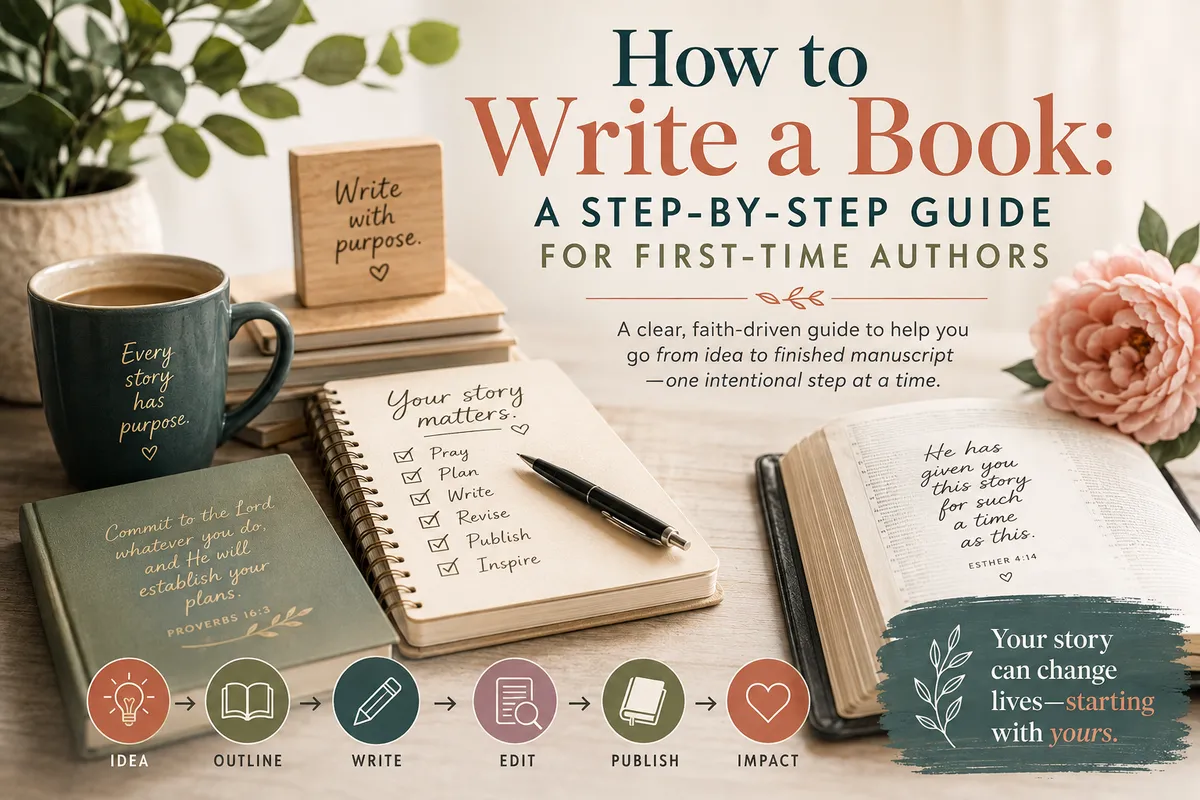
How to Write a Book: A Step-by-Step Guide for First-Time Authors
There’s a book inside you. You’ve felt it for a while now — in the story you keep retelling, the lesson you learned the hard way, the message you can’t seem to shake. The hard part isn’t the wanting. It’s knowing how to begin, and how to keep going until the last page.
Learning how to write a book for the first time feels overwhelming because the finished product looks so far away. You see other people’s polished books on shelves and can’t imagine how a blank page becomes one of them. But every author you admire started exactly where you are: with an idea and no clear plan.
This guide gives you the plan. We’ll walk through the entire writing process, step by step, so you always know your next move — from the first spark to a manuscript that’s ready to become a real book.
“For which of you, desiring to build a tower, does not first sit down and count the cost, whether he has enough to complete it?” — Luke 14:28
Writing a book is building a tower of words. Let’s count the cost, lay the foundation, and build it one steady stone at a time.
Step 1: Get Clear on Your Idea
Before you write a single chapter, get honest about what your book is really about. A vague idea produces a vague book. A focused idea produces a book that changes someone.
Answer three questions on paper:
- What is my book about, in one sentence? If you can’t say it simply, your reader won’t be able to either.
- Who is it for? Not “everyone.” Picture one real person — a young mom, a discouraged entrepreneur, a new believer — and write to them.
- What will change for that reader? Every good book promises a transformation, whether it’s hope, knowledge, healing, or a skill.
Write these answers down and keep them visible. They become your compass every time you feel lost in the middle.
Step 2: Choose Your Book’s Type and Structure
Different books are built differently. Knowing your type early saves you from rewriting later.
- Nonfiction and how-to books are usually organized by ideas or steps — each chapter teaches one thing.
- Memoirs and testimonies are organized around a journey or transformation, told through key moments in time.
- Business books blend teaching with story, often built around a framework or method you want readers to follow.
- Children’s books are shorter and built around a single message, rhythm, or lesson.
Once you know your type, you can pick a structure — chronological, problem-and-solution, or step-by-step. Structure is simply the order that makes your message easiest to follow.
Step 3: Create an Outline
An outline is the single most powerful tool for finishing a book. It turns one impossible task (“write a book”) into a series of doable ones (“write this chapter about this one thing”).
Start simple. List your chapters as working titles. Under each, jot three to five bullet points of what it will cover. Don’t aim for perfect — aim for a map you can follow and adjust. Most nonfiction books land somewhere between 8 and 15 chapters.
If the blank page intimidates you, this is where to slow down. We cover this in depth in our guide to building a strong book outline, which shows you how to structure a book that practically writes itself.
Step 4: Set a Realistic Writing Rhythm
Books aren’t written in heroic weekend marathons. They’re written in small, repeated sessions that add up.
Decide on a rhythm you can actually keep:
- A daily word count (even 300–500 words a day finishes a book in months).
- A set writing time (early mornings, a lunch break, two evenings a week).
- A weekly page or chapter goal.
Consistency beats intensity every time. An author who writes 500 words four days a week will finish long before the one waiting for a free weekend that never comes.
A practical tip: protect your writing time like an appointment. Put it on the calendar, silence your phone, and let the people around you know it’s sacred.
Step 5: Write a Messy First Draft
Here is the secret that frees most first-time authors: your first draft is allowed to be bad.
The goal of a first draft is not quality. It’s existence. You cannot edit a blank page, but you can always improve a rough one. So give yourself permission to write imperfectly — clunky sentences, missing facts, notes to yourself in brackets. Keep moving forward.
Many authors get stuck because they try to write and edit at the same time, which is like driving with one foot on the gas and one on the brake. Separate the two. Draft first. Polish later.
If you have a lot of ideas but struggle to get them onto the page, consider dictating your book out loud, or working with a ghostwriter who captures your voice through interviews. Speaking is often faster than typing, especially for pastors, coaches, and speakers who think best out loud.
Step 6: Push Through the Messy Middle
Almost every author hits a wall somewhere in the middle. The excitement of starting is gone, the finish line isn’t in sight, and doubt creeps in. This is normal — and it’s not a sign to quit.
When you stall, return to your compass from Step 1: who is this for, and what will change for them? Reconnecting with your reader is often enough to reignite your motivation. And when the block feels bigger than that, our guide on overcoming writer’s block offers practical ways to get moving again.
Remember: finishing a book is less about talent and more about perseverance. The authors who finish aren’t the most gifted. They’re the ones who kept showing up.
Step 7: Revise and Strengthen Your Manuscript
Once your rough draft exists, the real shaping begins. Revision is where a good book becomes a great one.
Work in passes rather than trying to fix everything at once:
- Big-picture pass — Does each chapter earn its place? Is the order logical? Does the promise from Step 1 get delivered?
- Chapter pass — Is each chapter focused on one clear idea? Does it flow?
- Line pass — Are your sentences clear? Have you cut repetition and filler?
Read your work out loud during this stage. Your ear catches what your eye misses — awkward phrasing, run-on sentences, and places where the energy drops.
Step 8: Prepare for Professional Editing
Even the strongest writers can’t fully see their own work. That’s not a weakness; it’s human. This is where professional editing transforms a manuscript.
There are different layers of editing, and knowing them helps you invest wisely:
- Developmental editing shapes the big picture — structure, clarity, and whether your message truly lands.
- Line and copy editing refine how your sentences read and correct grammar and consistency.
- Proofreading is the final polish that catches lingering typos.
A well-edited book signals to readers that you took your own message seriously. It’s one of the clearest markers of a professional author.
Step 9: Turn Your Manuscript Into a Book
Writing “The End” is a milestone worth celebrating — but it’s not the finish line. A finished manuscript still needs to become a published book: designed, formatted, assigned the right identifiers, and made available to readers.
That’s a whole journey of its own, and we walk through it in our companion guide on how to publish a book. For now, know that the hardest part — getting your message onto the page — will be behind you.
How Long Does It Take to Write a Book?
There’s no single answer, but here’s an honest range. A focused nonfiction book of 30,000–50,000 words often takes three to six months of consistent writing. Memoirs and more complex books can take longer. Writing part-time, around a busy life, naturally stretches the timeline — and that’s completely fine.
The authors who finish fastest usually aren’t writing more hours. They’re writing more consistently, and they started with a clear outline.
Common First-Time Author Mistakes to Avoid
A few predictable mistakes trip up first-time authors. Knowing them in advance saves you months of frustration:
- Editing while drafting. Trying to perfect each sentence as you write stalls your momentum. Draft first; polish later.
- Skipping the outline. Writing without a map is the number-one reason books stall in the middle.
- Writing for everyone. A book aimed at everyone connects with no one. Write to one specific reader.
- Comparing your first draft to someone’s finished book. You’re comparing your rough beginning to their polished end. It’s not a fair fight, and it’s not the truth.
- Waiting for the “perfect time” to write. It never comes. Small, consistent sessions beat waiting for a free weekend.
Avoid these five, and you’re already ahead of most people who set out to write a book.
You Don’t Have to Write It Alone
Here’s the encouraging truth: you don’t have to be a “writer” to become an author. Many of the most powerful books come from people who had a life-changing message but needed help shaping it — pastors, survivors, business leaders, and parents with wisdom to pass down.
If writing isn’t your gift, that doesn’t disqualify you. Book coaching keeps you accountable and structured. Ghostwriting captures your voice and story through conversation. At The 1 and Only Publishing, we help faith-driven authors turn their God-given message into a finished, professionally written book — whether you write every word yourself or speak it and let our team shape it.
Your story was placed in you for a reason. The world is waiting for the book only you can write.
Frequently Asked Questions
How do I start writing a book if I've never written before?
Start with clarity, not chapters. Write one sentence describing your book, name the one reader it's for, and the change you want them to experience. Then build a simple outline. Those three steps give first-time authors the direction they need to begin with confidence.
How many words should a book be?
It depends on the type. Most nonfiction and self-help books run 30,000–60,000 words. Memoirs often run 50,000–80,000 words. Children's books are far shorter. Focus less on hitting a number and more on fully delivering your message.
Do I have to write every word myself?
No. Many authors dictate their books, and others work with a ghostwriter who captures their voice through interviews. This is a common, respected path for busy leaders, pastors, and speakers who have a powerful message but limited time to write.
How do I stay motivated to finish my book?
Consistency and connection. Set a small, repeatable writing rhythm you can actually keep, and reconnect regularly with the reader you're writing for. Remembering who your book will help is often the strongest motivation to keep going.
What comes after I finish writing my book?
Revision and professional editing come first, followed by design, formatting, and publishing. Writing the manuscript is the biggest hurdle — once it's done, a good publishing partner can guide you through turning it into a finished book.
Write · Publish · Impact · Legacy
Ready to Finally Write the Book Inside You?
You’ve seen the whole path — now let’s map your idea, outline, and first pages. Book a free consultation and we’ll help you begin with confidence.
Schedule Your Free Consultation →Free consultation · No obligation · A clear next step for your book