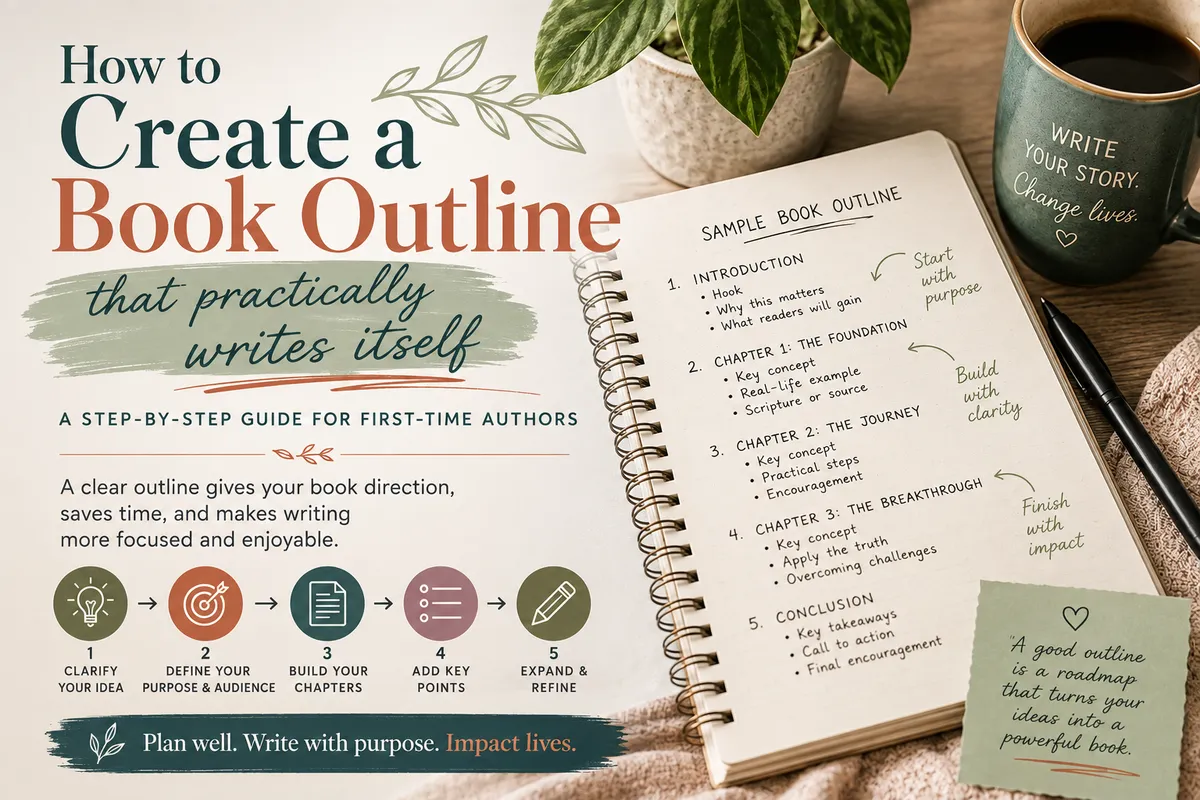
How to Create a Book Outline That Practically Writes Itself
Most books that never get finished don’t fail because the author lacked a message. They fail because the author sat down to write without a map — and got lost somewhere in the middle.
A strong book outline is that map. It’s the difference between staring at a blank page wondering what comes next, and sitting down each day knowing exactly what to write. An outline turns the overwhelming question “how do I write a book?” into a series of small, doable questions: “what does this one chapter need to say?”
If the word outline makes you picture rigid Roman numerals from a school assignment, relax. A book outline is simply a flexible plan you can follow and adjust. This guide shows you how to build one that gives your book direction and momentum.
“The plans of the diligent lead surely to abundance.” — Proverbs 21:5
Diligence starts with a plan. Let’s build yours.
Why Every Author Needs an Outline
Some writers resist outlining because they worry it will limit their creativity. In reality, the opposite is true. An outline frees you.
When you know where your book is going, you stop wasting energy on “what next?” and pour it into writing well. An outline gives you:
- Direction — you always know your next step.
- Momentum — small, defined tasks are far easier to start than one huge one.
- Protection against writer’s block — most blocks come from uncertainty, and an outline removes it.
- A sense of progress — checking off chapters keeps you motivated.
Think of your outline as scaffolding. You can adjust it, add to it, and even tear parts down as you build — but it holds everything in place while you work.
Step 1: Start With Your Core Message
Before chapters, start with clarity. Write one sentence that captures what your entire book is about and who it’s for. For example: “This book helps grieving parents find hope again through faith and practical daily habits.”
That single sentence becomes the filter for everything else. If an idea doesn’t serve that core message, it doesn’t belong in the book — no matter how good it is. This one discipline keeps your book focused and powerful instead of scattered.
Step 2: Brain-Dump Everything First
Before you organize, get everything out of your head. Grab a notebook or open a blank document and list every idea, story, lesson, question, and point you might want to include. Don’t judge or sort yet — just capture.
Give yourself permission to be messy here. You might end up with 40 or 50 scattered items. That’s exactly what you want. It’s much easier to organize a full pile of ideas than to invent them one at a time while writing.
Step 3: Group Ideas Into Chapters
Now look at your brain-dump and start grouping. Which ideas naturally belong together? Each cluster of related ideas usually becomes a chapter.
As you group, chapter themes will start to emerge. A book on faith-driven business might reveal clusters like calling, planning, money, marketing, and leadership. Each of those becomes a chapter with a clear job to do.
Aim for a chapter to cover one main idea. If a chapter is trying to do too much, split it. If two chapters feel thin, combine them.
Step 4: Put Your Chapters in Order
With your chapters defined, arrange them in the order that makes your message easiest to follow. The right order depends on your book:
- Chronological — for memoirs and testimonies that follow a journey through time.
- Step-by-step — for how-to and process-driven books where each chapter builds on the last.
- Problem to solution — for books that name a struggle, then guide the reader out of it.
- Simple to advanced — for teaching books that start with foundations and build up.
Read your chapter titles in order, top to bottom. Does the progression feel natural? Would a reader be able to follow the journey? Rearrange until it flows.
Step 5: Add Detail Under Each Chapter
Now zoom into each chapter. Under every chapter title, add three to five bullet points describing what it will cover — the key ideas, stories, and takeaways.
This is the level of detail that makes a book “practically write itself.” When you sit down to write Chapter 4, you’re not facing a blank page. You’re simply expanding five bullets you already thought through. Writing becomes filling in the blanks instead of inventing from nothing.
You don’t need full sentences here. Fragments are fine. The goal is a clear enough sketch that future-you knows exactly what to do.
A Simple Book Outline Template
If you’d like a starting point, here’s a clean, flexible structure you can adapt:
- Working Title — a draft title (you’ll refine it later)
- Core Message — one sentence: what the book does and for whom
- Introduction — the promise to the reader and why this book matters
- Chapter 1 — one main idea + 3–5 supporting bullets
- Chapter 2 — one main idea + 3–5 supporting bullets
- (Continue for each chapter — most nonfiction books run 8–15 chapters)
- Conclusion — the transformation, a final encouragement, and a next step
- Back matter — resources, acknowledgments, about the author
Fill this in loosely at first, then refine. Your outline is a living document, not a contract.
Keep Your Outline Flexible
Here’s an important mindset: your outline will change, and that’s a good sign, not a problem. As you write, you’ll discover better ideas, realize a chapter belongs earlier, or find that two chapters should merge. Let it evolve.
The outline exists to serve your book, not to trap it. Update it as you go, and it will keep serving you all the way to the final page.
How to Outline Different Types of Books
The same core method adapts to whatever you’re writing — the difference is what your chapters are organized around:
- Nonfiction and how-to: organize by ideas or steps. Each chapter teaches one concept or stage of a process, building logically toward the transformation you promised.
- Memoir: organize by moments in time. Your “chapters” are the key scenes and turning points of your journey, usually in chronological order.
- Business book: organize around your framework. If you take clients through a process, each step of that process becomes a chapter.
- Devotional or study: organize by theme or by day. Each entry stands alone while contributing to a larger arc.
Whatever your book, the principle holds: one clear job per chapter, arranged in the order that serves your reader best.
Common Outlining Mistakes to Avoid
As you build your outline, watch for a few traps that trip up first-time authors:
- Over-outlining. Some writers spend months perfecting an outline as a way to avoid the harder work of writing. Once your map is clear enough to follow, start writing.
- Under-outlining. The opposite problem — a list of chapter titles with no detail underneath. Those three to five bullets per chapter are what make writing easy, so don’t skip them.
- Treating it as permanent. A rigid outline you refuse to change will fight you. Let it evolve.
- Cramming too much into one chapter. If a chapter needs a dozen bullets, it’s probably two chapters.
- Forgetting the reader. Every chapter should move your reader closer to the transformation you promised. If one doesn’t, ask why it’s there.
Tools That Make Outlining Easier
You don’t need special software — a notebook works beautifully. But if you like digital tools, index cards (physical or digital) are wonderful for outlining because you can rearrange chapters freely. A simple document with headings works just as well. The best tool is the one you’ll actually use. Don’t let choosing an app become another form of delay.
From Outline to Finished Manuscript
Once your outline is in place, the writing itself becomes far less intimidating. You’ll simply work through your chapters one at a time, expanding each set of bullets into full paragraphs. This is exactly the momentum described in our broader guide on how to write a book.
And if you ever stall despite a solid outline, that’s normal too — our guide on writer’s block will help you get moving again.
You Don’t Have to Outline Alone
For many first-time authors, the outline is the hardest and most valuable part of the whole process — because it requires pulling a lifetime of experience, ideas, and stories into a clear structure. That can feel impossible when it’s all swirling in your head.
This is one of the most common places authors ask for help, and for good reason. At The 1 and Only Publishing, we help authors turn scattered ideas into a clear, compelling outline — often in a single focused session — so they can move forward with confidence. Sometimes one conversation is all it takes to see your whole book take shape.
Your message deserves a strong structure. With a good outline, the book you’ve been carrying finally has a path to the page.
Frequently Asked Questions
How detailed should a book outline be?
Detailed enough that you always know what to write next, but flexible enough to change. A good starting point is your core message, your chapters in order, and three to five bullet points under each chapter. You can add more detail as ideas become clear.
How many chapters should a book have?
Most nonfiction books have between 8 and 15 chapters, though there's no strict rule. Focus on giving each chapter one clear main idea rather than hitting a specific number. If a chapter tries to cover too much, split it.
What if my outline changes while I'm writing?
That's completely normal and usually a sign of progress. As you write, you'll discover better ideas and a better order. Treat your outline as a living document that serves your book, and update it freely as you go.
Do I need an outline for a memoir?
Yes, though it looks a little different. Instead of topic-based chapters, a memoir outline usually maps the key moments and turning points of your journey in order. Having that timeline keeps your story focused and moving forward.
Can someone help me create my outline?
Absolutely. Outlining is one of the most common places first-time authors seek help, because it requires organizing a lot of ideas at once. A book coach or publishing team can often help you build a full outline in a single focused conversation.
Write · Publish · Impact · Legacy
Feeling Scattered? Let’s Give Your Book a Clear Structure.
Book a free consultation and we’ll help you turn your ideas into a focused, chapter-by-chapter outline you can actually write from.
Schedule Your Free Consultation →Free consultation · No obligation · A clear next step for your book