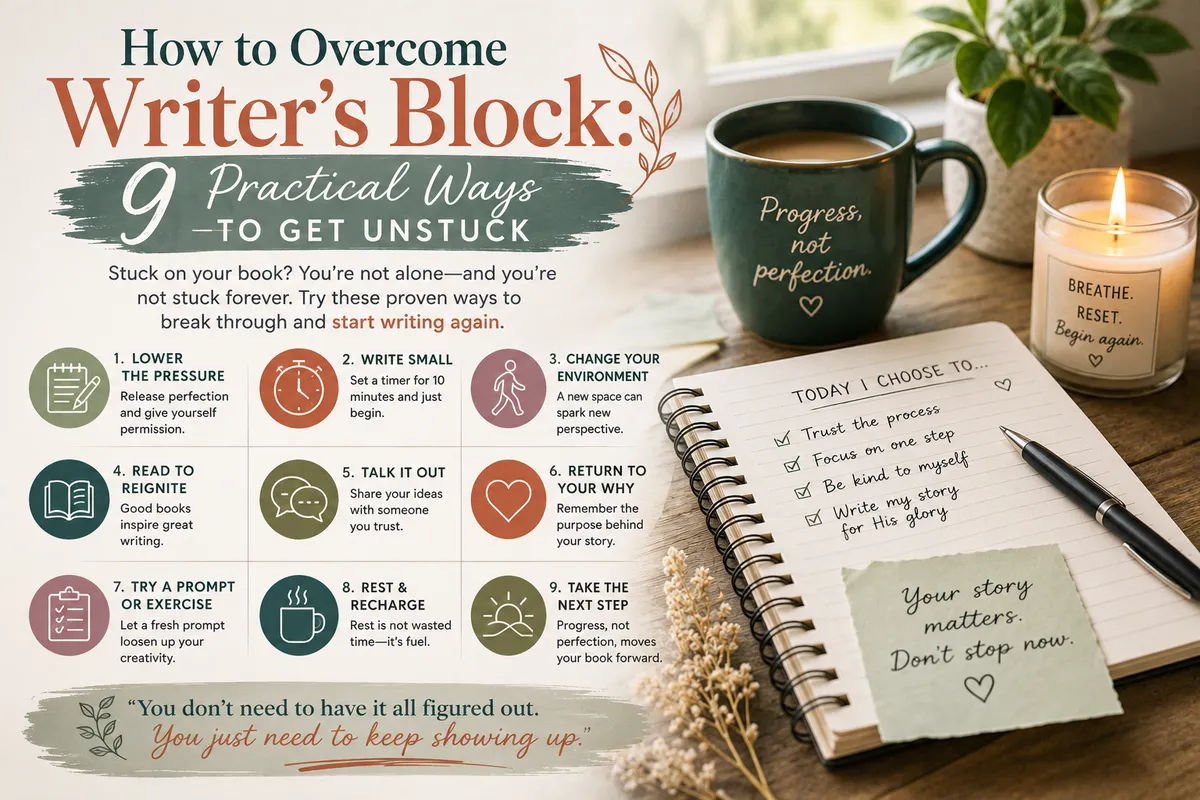
How to Overcome Writer's Block: 9 Practical Ways to Get Unstuck
You sat down to write, ready to make progress. Instead, the cursor blinks at you. The words won’t come. You reread the same paragraph five times, check your phone, and eventually walk away feeling like a failure.
If that’s you, take a breath. Writer’s block happens to nearly every author, including the ones whose finished books you admire. It is not a sign that you’re not meant to write your book. It’s a normal, solvable part of the process — and once you understand what’s actually causing it, you can work through it.
This guide covers what writer’s block really is, why it happens, and nine practical ways to get unstuck and moving again.
“Let us not grow weary of doing good, for in due season we will reap, if we do not give up.” — Galatians 6:9
Being stuck is not the end of your story. Let’s get you writing again.
What Writer’s Block Really Is
Writer’s block isn’t a lack of talent or ideas. Most of the time, it’s a symptom of something underneath — and naming that cause is half the solution.
The most common causes are:
- Uncertainty — you don’t know what to write next because you don’t have a clear plan.
- Perfectionism — you’re trying to write it perfectly the first time, so nothing feels good enough to keep.
- Fear — fear of judgment, of not being good enough, or of what people will think of your story.
- Overwhelm — the whole book feels too big to face, so you freeze.
- Depletion — you’re simply tired, drained, or running on empty.
Notice that none of these mean you can’t write. They mean something is standing between you and the page. Remove it, and the words return.
1. Return to Your Outline
If you don’t know what to write next, that’s not a talent problem — it’s a map problem. Go back to your book outline (or make one). When you can see your chapters and their key points, “what do I write?” gets answered for you. Uncertainty is the number one cause of blocks, and a clear outline dissolves it.
2. Give Yourself Permission to Write Badly
Perfectionism is a book-killer. When you demand a perfect first draft, you freeze, because nothing feels worthy. So flip the goal: your only job right now is to get words down, not good words. Write the worst version on purpose. You can fix a messy paragraph, but you can’t fix a blank one. Progress, not perfection.
3. Lower the Bar to Start
Big goals intimidate. Instead of “write this chapter,” tell yourself, “write for ten minutes” or “write 200 words.” Shrinking the task makes it easy to begin — and beginning is usually the hardest part. Nine times out of ten, once you start, momentum carries you well past your tiny goal.
4. Change Your Environment
Sometimes the block is your setting, not your story. Move to a coffee shop, a library, or a different room. Try writing at a different time of day. A fresh environment can reset your focus and break the association between “this spot” and “being stuck.”
5. Talk It Out Loud
If you can say it, you can write it. When you’re stuck, stop typing and simply talk — explain your chapter out loud to a friend, or record a voice memo describing what you want to say. Many authors discover their best material this way. You can transcribe the recording later and shape it into prose. For speakers, pastors, and coaches especially, talking is often far easier than typing.
6. Write Out of Order
Nothing says you must write your book from front to back. If Chapter 3 has you stuck, jump to Chapter 7 — the one you’re excited about. Momentum in any chapter is still momentum. Often, writing the exciting part loosens up the part that was stuck.
7. Reconnect With Your “Why”
When motivation fades, reconnect with the reason you started. Picture the one reader your book is for — the person who needs your message, your testimony, your wisdom. Writing gets easier when it stops being about you and becomes about them. Keep a note where you can see it: Who am I writing this for, and what will change for them?
8. Separate Writing From Editing
Trying to write and edit at the same time is like driving with one foot on the gas and one on the brake — you stall. Give yourself two different jobs on two different days. When drafting, silence your inner critic and just create. When editing, put your critic to work. Keeping them apart keeps the words flowing.
9. Rest Without Guilt
Sometimes the block is your body and mind telling you they’re depleted. Creativity needs fuel. If you’re exhausted, a real break — sleep, a walk, time in prayer, a day away — isn’t quitting. It’s refueling. Many authors return from a genuine rest with clarity they couldn’t force. Rest is part of the work, not the opposite of it.
A Simple Daily Practice to Prevent Blocks
The best way to beat writer’s block is to make it less likely in the first place. Two small habits do most of the work.
First, stop writing mid-thought. It sounds strange, but ending your session in the middle of a sentence or idea — rather than at a clean stopping point — gives you an easy on-ramp next time. You sit down already knowing what comes next.
Second, leave yourself a note. At the end of each session, jot a line about what you’ll write next: “Tomorrow: the story about the phone call, then the lesson about trust.” Future-you will thank you. That tiny breadcrumb removes the uncertainty that causes most blocks.
Take a Break or Push Through? How to Tell
Not every block should be pushed through, and not every one should be rested away. Here’s a simple way to tell the difference.
If you’re stuck but not drained — the ideas are there but you’re procrastinating or perfectionistic — push through. Lower the bar, set a ten-minute timer, and start. Momentum is the cure.
If you’re genuinely depleted — exhausted, empty, unable to think clearly — rest. Forcing words from an empty well produces writing you’ll delete anyway. A real break refills the well.
The honest question is: “Am I avoiding, or am I empty?” Avoiding calls for action. Empty calls for rest. Learning to tell them apart is one of the most useful skills a writer can develop.
Build a Ritual That Signals “Time to Write”
Your brain loves cues. Just as a bedtime routine tells your body it’s time to sleep, a small writing ritual can tell your mind it’s time to create — and that makes starting far easier.
Your ritual doesn’t need to be elaborate. It might be brewing the same cup of coffee, putting on the same instrumental playlist, lighting a candle, or opening with a short prayer for clarity. Do it consistently before each session, and before long the ritual itself starts pulling you into focus. The cue does part of the work that willpower used to do.
Pair this with a consistent time and place, and you remove a surprising amount of the friction that leads to blocks. You’re no longer negotiating with yourself every day about whether to write — you simply follow the routine, and the writing follows.
The Myth of Waiting for Inspiration
One belief keeps more authors stuck than any other: the idea that you should wait until you feel inspired to write. It sounds reasonable. It’s also a trap.
Inspiration is wonderful when it comes, but it’s an unreliable employer. If you only write when you feel like it, you’ll write rarely — and your book may never get finished. Professional writers know a secret amateurs don’t: inspiration usually shows up after you start, not before. You sit down, write badly for ten minutes, and somewhere in there the flow arrives.
So flip the order. Don’t wait to feel like writing in order to write. Write in order to feel like writing. Show up on schedule, lower the bar, and let momentum do what motivation couldn’t. The habit of writing is far more powerful than the feeling of wanting to.
When the Block Is Deeper
Sometimes writer’s block isn’t about technique at all. For authors writing hard stories — grief, trauma, a painful season — the “block” is often the heart protecting itself from difficult material. That’s not weakness; it’s human.
If that’s you, be gentle with yourself. Write the easier parts first. Consider talking through the hard chapters with a trusted friend, counselor, or writing partner before you put them on the page. Your story matters, and there’s no prize for rushing through pain.
You Don’t Have to Push Through Alone
Here’s something reassuring: many authors who feel “blocked” simply need a thinking partner. When you talk your book through with someone who knows how to draw it out, the words that felt stuck suddenly flow.
That’s a big part of what book coaching and ghostwriting provide. At The 1 and Only Publishing, we help faith-driven authors get unstuck — through structure, encouragement, and even interview-based writing where we capture your message as you speak it. If the page feels impossible, you don’t have to face it by yourself.
Being stuck is not the end. It’s just a moment in the process — and every author who finished a book moved through it. You will too.
Frequently Asked Questions
Is writer's block real?
Yes, though it's usually a symptom rather than a mystery. Most blocks come from uncertainty, perfectionism, fear, overwhelm, or exhaustion. Once you identify which one is affecting you, you can address the real cause and start writing again.
Why do I get writer's block in the middle of my book?
The middle is where the excitement of starting fades and the finish line still feels far away. Doubt and fatigue often creep in here. Reconnecting with your outline and your reason for writing usually helps you push through this common stretch.
How do I start writing again when I'm stuck?
Lower the bar. Instead of writing a whole chapter, commit to ten minutes or 200 words. Give yourself permission to write badly, and consider talking your ideas out loud first. Small, easy starts break the freeze faster than waiting for motivation.
Does writer's block mean I'm not a good writer?
Not at all. Being blocked has nothing to do with talent — even bestselling authors experience it. It simply means something is standing between you and the page, and that something can be removed.
What if I'm blocked because my story is painful?
Be gentle with yourself. When the material is emotionally hard, the block is often your heart protecting you. Write the easier parts first, and consider talking the difficult chapters through with a trusted person or writing partner before drafting them.
Write · Publish · Impact · Legacy
Stuck on Your Manuscript?
Sometimes one conversation is all it takes to get moving again. Book a free consultation and we’ll help you find the block, clear it, and get writing.
Schedule Your Free Consultation →Free consultation · No obligation · A clear next step for your book