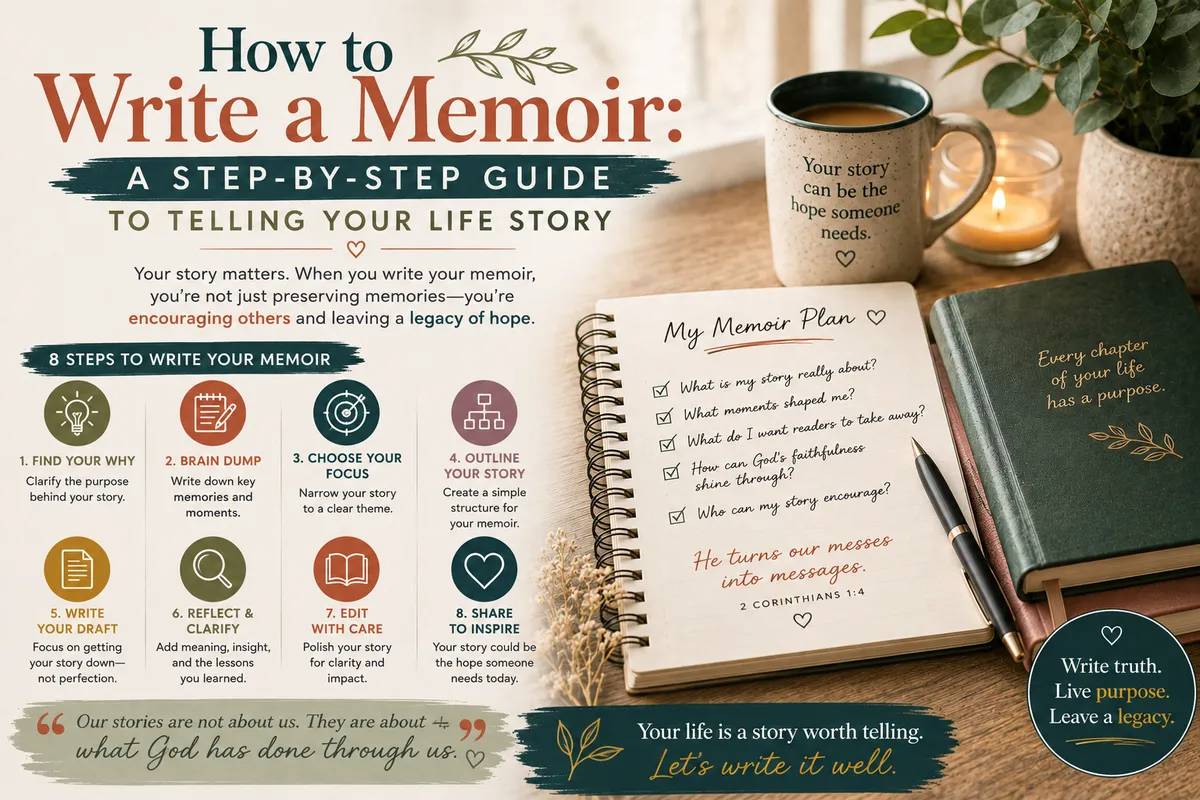
How to Write a Memoir: A Step-by-Step Guide to Telling Your Life Story
You’ve lived a story worth telling. Maybe several. And somewhere along the way, people started saying it — “You should write a book.” The question is how to take a lifetime of memories and turn them into a memoir someone would actually want to read.
Learning how to write a memoir is different from writing an autobiography or a testimony. A memoir isn’t the entire timeline of your life. It’s a focused, meaningful slice of it — shaped into a story with a beginning, a middle, and a transformation. Done well, a memoir doesn’t just record what happened. It helps the reader feel it, and find something for their own life inside yours.
This guide walks you through how to focus, structure, and write a memoir that lasts.
“One generation shall commend your works to another, and shall declare your mighty acts.” — Psalm 145:4
A memoir is one generation speaking to the next. Let’s help yours speak clearly.
Memoir vs. Autobiography: Know the Difference
These words are often used interchangeably, but they’re not the same, and knowing the difference will make your book far stronger.
- An autobiography covers the full span of a person’s life, in order, from birth onward. It aims to be comprehensive.
- A memoir focuses on a specific theme, season, or journey within a life. It aims to be meaningful.
Most readers connect far more with memoir. A book that tries to include everything often feels like a list. A book that focuses on one powerful journey — a hard season you survived, a calling you followed, a relationship that changed you — pulls readers in and holds them. Focus is your friend.
Step 1: Find Your Memoir’s Focus
Before writing, decide what your memoir is really about. Not the events — the meaning. Ask yourself:
- What season or theme of my life carries the most weight?
- What did I learn, lose, or become through it?
- What would a reader gain from walking through it with me?
Your answer becomes your memoir’s spine. Everything you include should connect to it. This single decision is what separates a memoir people finish from one they set down.
Step 2: Gather Your Memories
Once you know your focus, mine your memory for the moments that belong to it. Don’t worry about order yet — just collect.
Helpful prompts:
- The turning points — moments after which nothing was the same.
- The people who shaped this part of your story.
- The sensory memories — a place, a smell, a song, a room you can still see.
- The hard moments and the moments of grace.
Write these down as a list or in quick notes. You’re building the raw material you’ll later shape into scenes.
Step 3: Structure Your Story
A memoir needs a shape, or it becomes a pile of memories. Most memoirs use one of these structures:
- Chronological — telling the season in the order it happened. Simple and effective.
- Framed — opening at a pivotal moment, then circling back to show how you got there.
- Thematic — organizing around ideas or lessons, moving through time within each.
For most first-time memoirists, chronological is the clearest place to start. Sketch your key moments into a rough order — this is your memoir’s version of a book outline. Having that map keeps you focused and moving.
Step 4: Write in Scenes
The single biggest difference between a forgettable memoir and a gripping one is scenes. A scene puts the reader inside a moment rather than summarizing it from a distance.
Instead of “My father was a hard man,” write the moment: the dinner table, the thing he said, the way the room went quiet. Let the reader draw the conclusion by experiencing it with you.
Good scenes include:
- Place — where were you? Ground the reader.
- Sensory detail — what did you see, hear, smell?
- Dialogue — what was actually said (as best you remember).
- Emotion — what you felt, shown through action rather than just stated.
You won’t write everything in scene — some summary is necessary to move through time. But your key moments deserve to be lived, not told.
Step 5: Tell the Truth With Grace
Memoir is built on truth, and truth is what makes it powerful. But truth in memoir comes with responsibility, especially toward the real people in your story.
A few principles that serve memoirists well:
- Write your truth, from your perspective. You’re telling your experience, not issuing a verdict on others.
- Protect privacy where wisdom calls for it. Changing names or identifying details is common and appropriate.
- Aim for redemption over revenge. The most moving memoirs are honest about pain but written from a place of healing, not bitterness.
Your reader will trust you more when you’re honest about your own failures, not just others’. Vulnerability is the heart of memoir.
Step 6: Find the Universal in the Personal
Here’s what turns your personal story into a book strangers want to read: the universal thread inside it. Readers don’t pick up a memoir because they lived your exact life. They pick it up because something in your story speaks to something in theirs — grief, resilience, faith, forgiveness, second chances.
As you write, keep asking, “What’s the bigger truth here that a reader could carry into their own life?” You don’t have to spell it out heavily. Just make sure it’s there, quietly offering the reader something to hold onto.
What to Do About Memory Gaps
Every memoirist worries about this: “What if I don’t remember exactly how it happened?” Relax — memoir is understood to be memory, not a courtroom transcript. Readers don’t expect perfect recall; they expect emotional truth.
A few honest approaches help:
- Write what you genuinely remember, and let the gaps be gaps. You can acknowledge uncertainty (“I don’t remember what she wore, but I remember the silence”).
- Reconstruct scenes faithfully. It’s accepted practice to recreate dialogue and detail as best you recall, capturing the truth of the moment even if the exact words are lost.
- Fill gaps with research. Old photos, letters, journals, and conversations with family can bring back details you’d forgotten.
The goal is faithfulness to your experience, not flawless documentation.
Common Memoir Mistakes to Avoid
A few missteps weaken otherwise-powerful memoirs. Watch for these:
- Trying to include everything. The cure is focus. A memoir is a slice, not the whole pie.
- Summarizing instead of showing. Key moments deserve scenes, not a paragraph of overview.
- Settling scores. Bitterness makes a memoir smaller. Redemption makes it universal.
- Making yourself the flawless hero. Readers trust authors who are honest about their own failures.
- Forgetting the reader. Even the most personal memoir should offer the reader something to carry into their own life.
Read Like a Memoirist
One of the best things you can do for your own memoir is to read a few memoirs you admire — not just for the story, but for the craft. Notice how the author opens. Watch how they move between scene and reflection. See how they handle the passage of time, and how they weave meaning through the story without preaching.
You’re not copying anyone; you’re learning the tools. Every strong memoir you read quietly teaches you how to shape your own. Keep a note of moments that moved you and ask, “How did they do that?” That simple habit will sharpen your writing faster than almost anything else — and it makes the work feel less lonely.
Writing a Faith-Centered Memoir
For many authors, a memoir is inseparable from faith — because the story of your life is really the story of God’s faithfulness through it. If that’s you, let that thread run naturally through your book. You don’t have to turn every chapter into a sermon; simply telling the truth about where God met you is often the most powerful witness of all. If your book leans heavily on a single spiritual turning point, our guide on how to write your testimony is a helpful companion.
You Don’t Have to Write It Alone
A memoir asks a lot of an author. It requires remembering, sometimes reliving, and shaping tender material into art. Many people with an extraordinary story feel stuck simply because they aren’t sure how to turn their memories into a manuscript — or because writing it alone feels heavy.
That’s exactly the kind of book we love to help bring to life. At The 1 and Only Publishing, we help authors shape their life stories into beautiful, focused memoirs — including through interviews, where we capture your memories in conversation and craft them into scenes and chapters. Your legacy deserves to be told well.
The story of your life is a gift to the generations after you. Let’s make sure it’s written down before it’s lost — and written in a way people will treasure.
Frequently Asked Questions
What's the difference between a memoir and an autobiography?
An autobiography covers your entire life in chronological order and aims to be comprehensive. A memoir focuses on a specific theme, season, or journey and aims to be meaningful. Most readers connect more deeply with the focus of a memoir than the full timeline of an autobiography.
How do I choose what to include in my memoir?
Start by choosing your focus — the season or theme your memoir is really about. Then include the moments, people, and details that connect to that focus, and set aside the ones that don't. A clear focus is what keeps a memoir from feeling like a list of events.
How long is a typical memoir?
Most memoirs run roughly 50,000 to 80,000 words, though there's flexibility. Rather than aiming for a number, aim to fully tell your focused story. A shorter, focused memoir is far better than a long, unfocused one.
How do I write about family members honestly?
Write your truth from your own perspective, protect privacy where wisdom calls for it (changing names or details is common), and aim for grace over bitterness. Being honest about your own struggles, not just others', builds trust with readers.
Can someone help me write my memoir?
Yes. Because memoirs require shaping personal memories into scenes, many authors work with a book coach or ghostwriter who draws out their story through conversation and crafts it into a manuscript. This is a common and meaningful path, especially for preserving a legacy.
Write · Publish · Impact · Legacy
Ready to Preserve Your Life Story?
Book a free consultation and we’ll help you focus, structure, and write a memoir your family and readers will treasure for generations.
Schedule Your Free Consultation →Free consultation · No obligation · A clear next step for your book