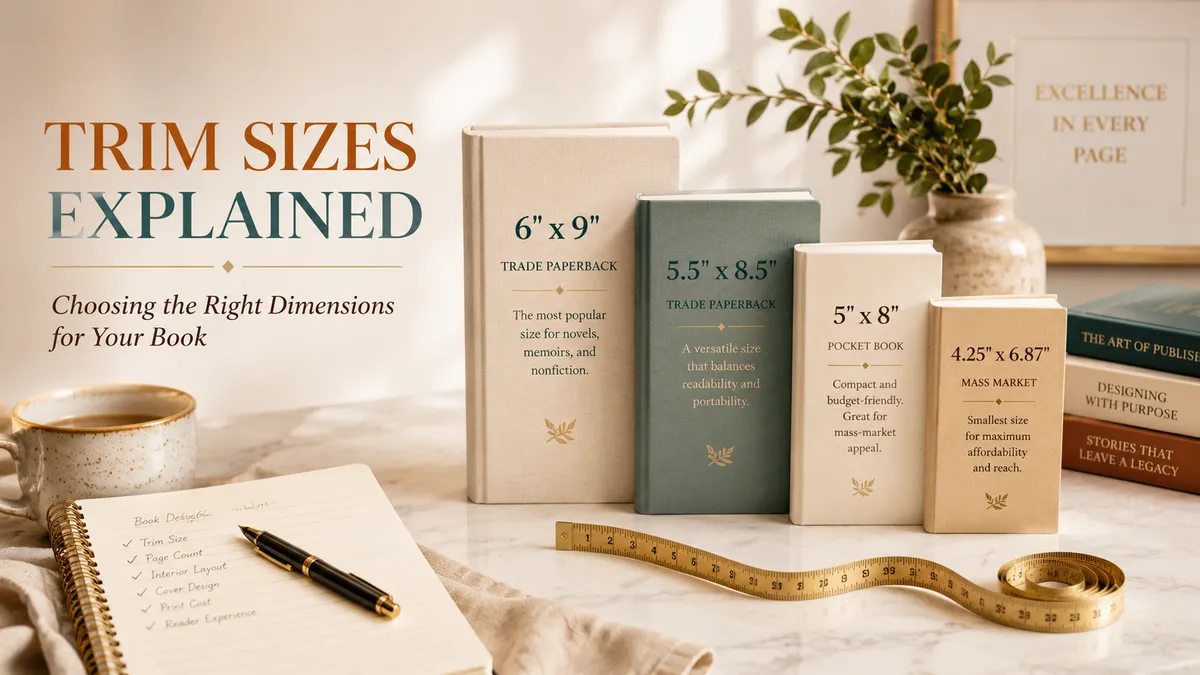
Trim Sizes Explained: Choosing the Right Dimensions for Your Book
If you’ve never published a book before, “trim size” might be the first publishing term you encounter that feels genuinely unfamiliar. It’s not a phrase most people use in everyday life, and yet it’s one of the earliest and most consequential decisions in your entire publishing process — one that quietly shapes your cover design, your page count, your printing cost, and even how your book feels in a reader’s hands.
Trim size simply refers to the finished, physical dimensions of your printed book after the pages have been trimmed to their final size — the height and width you’d measure with a ruler if you picked up the finished copy. It has nothing to do with your book’s content or genre requirements in a legal sense, but it has everything to do with reader expectations, since certain sizes have become strongly associated with certain kinds of books over decades of publishing convention.
Why Trim Size Isn’t Just a Technical Detail
It’s tempting to think of trim size as a back-end printing decision your formatter or printer can simply handle for you. In one sense, that’s true — you don’t need to become a print production expert. But the size you choose has real, visible consequences:
- Page count. A smaller trim size means more pages for the same word count, which affects your spine width, printing cost per copy, and retail price.
- Reader expectations. A business book in an oversized trim can feel unwieldy; a memoir in a tiny trim can feel cramped. Readers have subtle, often unconscious expectations shaped by years of exposure to standard sizes in each genre.
- Cover design. Your cover artist needs your final trim size before finalizing layout, since spine width and full wraparound dimensions depend directly on it.
- Shelf and display compatibility. If your book will be sold in physical bookstores, an unusual trim size can create challenges for shelving and point-of-sale displays.
Pilot and author Antoine de Saint-Exupéry, reflecting on design more broadly, captured exactly the discipline trim size decisions require:
“Perfection is achieved, not when there is nothing more to add, but when there is nothing left to take away.”
— Antoine de Saint-Exupéry
Choosing the right trim size is rarely about finding the biggest or most impressive option — it’s about finding the size that fits your book precisely, with nothing wasted and nothing missing.
Standard Trim Sizes by Genre
While there’s no rule requiring you to follow convention, most successful books fall within a fairly narrow range of standard sizes, because printers, distributors, and readers are all calibrated to expect them:
- 5” x 8” or 5.25” x 8” — Common for novels and narrative nonfiction, including memoir. This size feels approachable and portable, and it’s often the default recommendation for fiction and story-driven books.
- 5.5” x 8.5” — A popular general-purpose size for a wide range of nonfiction, including business books, self-help, and Christian living titles. It offers a bit more room per page, which can reduce total page count for longer manuscripts.
- 6” x 9” — Common for business books, longer nonfiction, and some memoir. This size reads as substantial and professional, which is part of why it’s a frequent choice for authors positioning themselves as experts in their field.
- 8.5” x 11” — Standard for workbooks, journals, and any book with worksheets, illustrations, or content meant to be written in.
- 8.5” x 8.5” or similar square formats — Frequently used for children’s picture books, where illustrations benefit from generous, balanced page space. (See our companion guide on children’s illustrations for more on formatting picture books specifically.)
How Trim Size Affects Your Printing Cost
Print-on-demand pricing (used by platforms like Amazon KDP and IngramSpark) is generally calculated using page count, trim size, and whether your book is black-and-white or full color. A smaller trim size at the same word count produces more pages, which can increase your per-unit printing cost — sometimes enough to affect your retail pricing strategy in a meaningful way. Before finalizing your trim size, it’s worth running your expected word count through your printer’s cost calculator at two or three candidate sizes so you understand the tradeoffs before you commit.
A Word on Precision
Every measurement in trim size selection matters more than it might initially seem — a difference of even a quarter inch changes your spine width calculation, your cover template, and potentially your printing cost. Scripture offers a fitting principle here, even though it was written about something entirely different:
“A false balance is an abomination to the LORD, but a just weight is his delight.”
— Proverbs 11:1
The underlying idea — that precision and honesty in measurement matter, even in small things — is a helpful posture to bring to a decision like trim size. Getting it right the first time saves real cost and rework later.
Matching Trim Size to Your Book’s Purpose
Trim size should ultimately serve your reader’s experience, not just industry habit. A few questions can help you land on the right choice:
- What do comparable books in my genre typically use? Pull five to ten bestsellers in your specific category and note their trim sizes — you’ll likely see a clear pattern.
- How long is my manuscript? A very long manuscript in a small trim size may result in an unusually thick spine; a very short manuscript in a large trim size may look thin and underwhelming.
- Will readers be writing in it, referencing it repeatedly, or reading it cover to cover once? Workbooks and reference materials often benefit from larger trims that allow more white space per page.
- Am I planning both print and audiobook or ebook editions? Trim size only affects the print edition, but it’s worth confirming your formatter understands your full publishing plan so nothing is built in isolation.
Working Trim Size Into Your Publishing Timeline
Trim size needs to be decided early — ideally before your book goes into interior formatting and before your cover designer finalizes the wraparound file, since the cover’s spine width is calculated directly from your trim size and final page count. Making this decision late in the process, after cover concepts are already underway, is one of the more common (and avoidable) sources of rework for first-time authors.
At The 1 and Only Publishing, trim size is part of the initial production conversation in our publishing services, considered alongside your genre, your manuscript length, and your overall design vision — so every downstream decision, from formatting to cover to printing cost, is built on a solid foundation from day one.
Trim Size and Special Content
If your book includes photographs, charts, illustrations, or wide tables, trim size deserves even more careful thought. A narrow trim size can force awkward compromises — shrinking images to the point of losing detail, or splitting a wide table across two pages in a way that frustrates readers. Business and ministry leadership books that rely on diagrams or frameworks often benefit from a slightly larger trim size like 6” x 9” specifically to give that visual content room to breathe.
Children’s books are their own category entirely. Because illustration is often equally or more important than text, picture books frequently use square or near-square trim sizes (8” x 8” or 8.5” x 8.5” are common) that give illustrators a balanced canvas rather than the tall, narrow shape of a typical novel. If you’re working on a children’s book, it’s worth deciding on trim size in conversation with your illustrator before final artwork begins, since resizing finished illustrations after the fact rarely looks as good as artwork built for the correct dimensions from the start.
Trim Size Mistakes First-Time Authors Make
- Choosing a trim size based on personal preference alone, without checking what readers in that genre actually expect. A striking, unusual choice can work, but it should be intentional, not accidental.
- Deciding on trim size after the cover concept is already underway. Because spine width depends on final page count at your chosen trim size, a late change often means the cover has to be substantially reworked.
- Assuming trim size doesn’t matter for ebooks, and therefore not confirming with a formatter which decisions apply to print only versus both formats.
- Not testing page count estimates before committing, which can lead to unpleasant surprises about printing cost once the manuscript is fully formatted.
- Overlooking how a chosen size will read in a printed proof. A trim size that looks fine described in a spec sheet can feel different once you’re holding an actual printed copy — always request a physical proof before finalizing.
A Quick Gut Check
If you’re still unsure, ask yourself how you want your book to feel in a reader’s hands. Substantial and authoritative? A 6” x 9” trim leans that direction. Warm and easy to carry? A 5” x 8” trim feels more intimate. There’s no wrong answer as long as it’s an intentional one, made with your genre and your reader in mind rather than left to chance.
Frequently Asked Questions
What is the most common trim size for a first book?
It depends heavily on genre. Narrative nonfiction and memoir often use 5" x 8" or 5.25" x 8"; general nonfiction and Christian living titles often use 5.5" x 8.5"; business books often use 6" x 9". Reviewing comparable titles in your specific category is the most reliable way to choose.
Can I change my trim size after formatting has started?
Technically yes, but it typically means re-flowing your entire interior layout and recalculating your cover's spine width, which usually costs additional time and, depending on your formatter's process, additional fees. It's best to lock in trim size before formatting begins.
Does trim size affect my ebook?
No. Ebook formatting is reflowable and adjusts automatically to the reader's device and font size preferences, so trim size only applies to your print edition.
Will an unusual trim size hurt my chances of getting into bookstores?
It can create friction. Bookstores are set up to shelve standard sizes efficiently, and printers may charge more or have longer lead times for non-standard dimensions. Sticking to an established size in your genre is generally the safer choice unless you have a specific creative reason to do otherwise.
How do I know my exact page count before choosing a trim size?
Your formatter can typically give you an estimated page count at a couple of candidate trim sizes based on your manuscript's word count, since a smaller trim size produces more pages for the same content. This estimate helps you compare printing costs before committing.
Write · Publish · Impact · Legacy
Not Sure Which Trim Size Fits Your Book?
Book a free consultation and we’ll help you choose the right size for your genre and budget.
Schedule Your Free Consultation →Free consultation · No obligation · A clear next step for your book