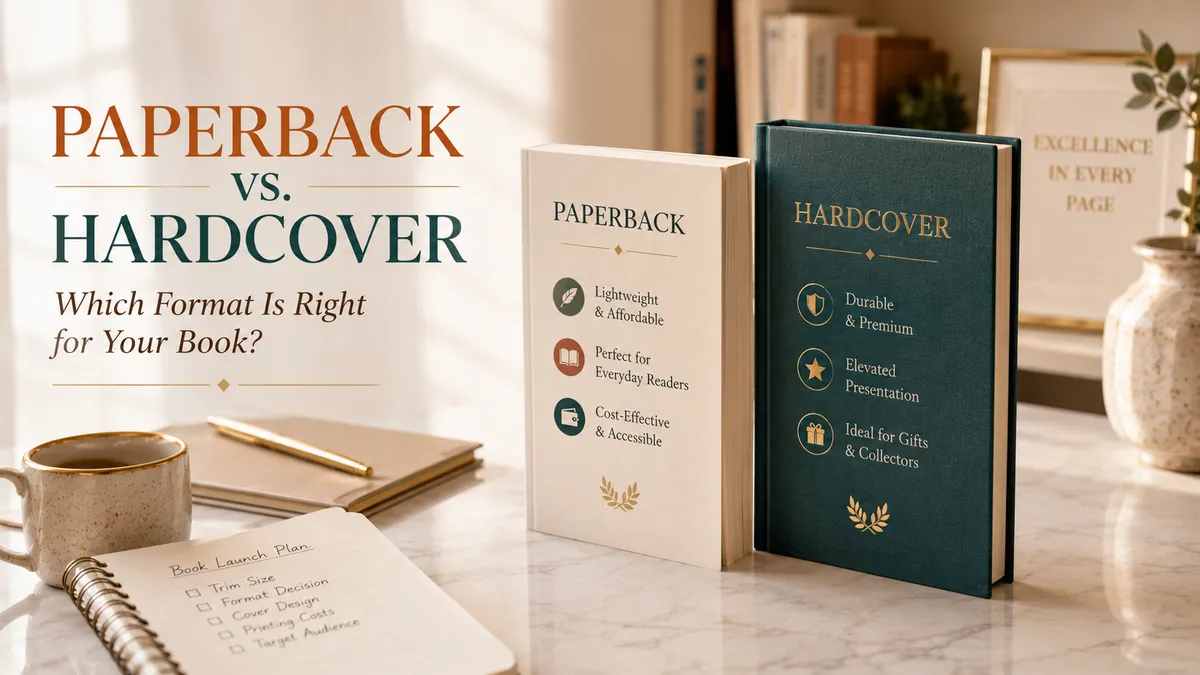
Paperback vs. Hardcover: Which Format Is Right for Your Book?
Somewhere in the excitement of finishing your manuscript, a very practical question arrives: should your book be a paperback, a hardcover, or both? It seems like a small decision compared to writing the book itself, but it touches nearly everything downstream — your printing cost, your retail price, your profit margin, and even how readers perceive your book before they’ve read a single word.
There’s no universally “better” choice here. The right format depends on your genre, your budget, your audience, and what you’re hoping this particular edition will accomplish. Let’s walk through what actually separates the two, so you can make this decision with confidence instead of guesswork.
What Actually Differs Between the Two
At the most basic level, a paperback has a flexible cover made of coated cardstock, while a hardcover (also called a “casebound” or “cloth” edition) has a rigid board cover, often wrapped in a printed paper jacket or, less commonly, printed directly on the case. But the differences run deeper than just the cover material:
- Durability. Hardcovers hold up to repeated handling and shelf life better than paperbacks, which is part of why libraries and long-term reference books often favor them.
- Perceived value. Readers often associate hardcover editions with higher production value, which can support a higher retail price.
- Printing cost. Hardcovers cost significantly more to produce per unit than paperbacks, due to the additional materials and binding process.
- Shipping weight and cost. Hardcovers are heavier, which affects shipping costs for both you and your customers if you’re fulfilling orders directly.
- Gift and collector appeal. Hardcovers are often chosen for legacy books, memoirs meant to be passed down, or special editions intended as gifts.
Why This Decision Matters More Than It Seems
Stephen King, reflecting on the enduring appeal of books themselves, wrote:
“Books are a uniquely portable magic.”
— Stephen King
That portability and lasting power is exactly what’s at stake in the paperback-versus-hardcover decision. A paperback maximizes accessibility — it’s lighter, cheaper, and easier for a reader to pick up on impulse. A hardcover maximizes permanence — it says “this book is meant to last,” which matters enormously for certain kinds of books and readers.
When Paperback Is the Better Choice
For most first-time authors, paperback is the practical starting point, and for good reason:
- Lower printing cost means a lower retail price, which reduces friction for readers discovering you for the first time.
- Better margins on print-on-demand platforms, since hardcover print-on-demand costs can eat significantly into your royalty per copy.
- Faster, simpler production, since paperback files are generally more straightforward to set up and proof.
- Genre expectations. Many genres — including most fiction, memoir, and general nonfiction — sell primarily in paperback, especially for debut authors without an established readership yet.
When Hardcover Makes Sense
Hardcover is worth considering, either as your primary format or as a companion edition alongside paperback, when:
- Your book is intended as a legacy piece — a family history, a testimony meant to be handed down, or a ministry resource meant to sit on a shelf for years rather than be read once and passed along.
- You’re targeting gift-giving occasions, such as graduation, ordination, or milestone anniversaries, where a hardcover’s perceived value matters to the buyer.
- Your book will be sold through channels that favor hardcover, such as certain specialty retailers, church bookstores, or speaking engagement back-of-room sales, where a premium physical presence supports a premium price.
- Illustration or photography is central to the book, since hardcover construction often (though not always) pairs with heavier interior paper stock that reproduces images more richly.
Offering Both Formats
Many authors ultimately choose to offer both — a paperback as the primary, accessible edition and a hardcover as a premium option, often priced noticeably higher. This mirrors how traditional publishers frequently release titles: sometimes hardcover first, with paperback following later; sometimes both simultaneously for self-published and hybrid-published authors using print-on-demand.
If you go this route, a few practical notes matter:
- Both editions need separate cover files, since hardcover typically requires either a printed jacket or case-wrap design, which differs technically from a paperback’s single-piece cover file.
- Interior formatting is usually shared, but always confirm with your formatter or printer, since paper stock differences can occasionally affect page count or spine width slightly.
- Pricing strategy should be intentional. A hardcover priced only slightly above paperback undersells its own premium positioning; a hardcover priced dramatically higher needs to clearly justify that gap for the reader.
The Legacy Angle for Faith-Driven Authors
For many authors working with The 1 and Only Publishing, the “why” behind their book is inseparable from the idea of legacy — preserving a testimony, a ministry teaching, or a family story for future generations. That mission-driven motivation, more than pure economics, often tips the scale toward hardcover for at least a portion of print run, even when paperback remains the primary retail edition.
Scripture speaks directly to this idea of lasting impact versus fleeting things:
“The grass withers, the flower fades, but the word of our God will stand forever.”
— Isaiah 40:8
A hardcover won’t make your message more true or more lasting in any spiritual sense — but for authors specifically hoping to create a physical object meant to endure on a shelf for decades, the format choice can be a meaningful way to reflect that intention.
Common Misconceptions About Format Choice
A few beliefs about paperback and hardcover circulate widely among first-time authors, and it’s worth clearing them up before you decide:
- “Hardcover automatically makes my book look more legitimate.” A well-designed paperback with a professional cover and clean interior formatting reads as entirely legitimate to most readers. Format alone doesn’t substitute for quality design and editing.
- “Paperback is only for books that don’t matter as much.” Some of the most significant, best-selling nonfiction and memoir of the last several decades has been paperback-first. Format is a strategic choice, not a statement about a book’s importance.
- “I should decide format based on what I’d personally prefer to hold.” Your own preference matters less than your reader’s likely path to purchase and your genre’s conventions. A memoir author who loves hardcovers personally may still be better served starting in paperback if their audience is primarily discovering the book online.
- “Offering both formats doubles my work.” Much of the underlying interior formatting can carry over between formats with a professional formatter, so offering both is usually a matter of additional file setup rather than starting over completely.
Thinking About Format as Part of Your Launch Strategy
Your format decision doesn’t happen in isolation — it connects to your pricing strategy, your marketing plan, and how you’re positioning the book for launch. A hardcover-first release paired with a strong pre-order campaign can create a sense of occasion around a launch, particularly for ministry leaders or speakers who already have an audience anticipating the book. A paperback-first, lower-price approach can work well for authors prioritizing wide reach and discoverability over premium positioning from day one.
Neither approach is right or wrong on its own. What matters is that your format decision supports the broader goals you have for the book — whether that’s building an email list, establishing authority in your field, generating speaking opportunities, or simply getting your story into as many hands as possible.
A Note on Distribution Channels
Your format choice can also affect where your book is realistically able to sell. Some specialty retailers, church resource stores, and gift shops prefer hardcover for shelf display and perceived durability, especially for books intended to be given rather than casually browsed. Online retail, by contrast, tends to favor paperback for its lower price point and faster impulse-purchase potential. If you already have a sense of where you expect most of your sales to happen — your own website, a specific retail partner, speaking engagements, or general online marketplaces — it’s worth checking whether that channel has a format preference before finalizing your plan.
How to Decide, Practically
If you’re still unsure, work through these questions in order:
- Who is my primary reader, and how are they most likely to discover and buy this book — an impulse purchase online, or a considered gift purchase?
- What does my printing cost calculator show for both formats at my chosen trim size and page count?
- Do comparable titles in my genre lean toward one format or the other?
- Is this book meant primarily to be read once, or to be kept and referenced for years?
- Do I have the budget and inventory strategy to support offering both formats well, or should I start with one and add the other later based on demand?
There’s no wrong answer here as long as it reflects a real decision rather than a default. Both formats can serve your book well — the key is choosing intentionally, with your reader and your purpose in mind.
Frequently Asked Questions
Is hardcover always more expensive to produce than paperback?
In print-on-demand publishing, yes — hardcover consistently costs more per unit due to the additional materials and binding process. Exact cost differences vary by printer and specifications, so it's worth requesting a quote for both formats before deciding.
Can I start with paperback and add hardcover later?
Yes, and many authors do exactly this. Starting with paperback lets you test demand before investing in a second format, and most print-on-demand platforms make adding a hardcover edition later a straightforward process.
Does hardcover typically sell better than paperback?
It depends heavily on genre and audience. For many first-time authors, paperback outsells hardcover simply due to lower price and lower barrier to purchase, though gift-oriented or legacy-focused books can perform well in hardcover.
Do I need different interior formatting for hardcover versus paperback?
Often the core interior layout can be shared, but always confirm with your formatter, since paper stock and binding differences can occasionally require small adjustments.
What about audiobooks and ebooks — do they fit into this decision?
Format decisions for paperback and hardcover are separate from ebook and audiobook production, though all three can be planned together as part of a complete publishing strategy for your book.
Write · Publish · Impact · Legacy
Paperback, Hardcover, or Both?
Book a free consultation and we’ll help you choose the right format for your book and your readers.
Schedule Your Free Consultation →Free consultation · No obligation · A clear next step for your book