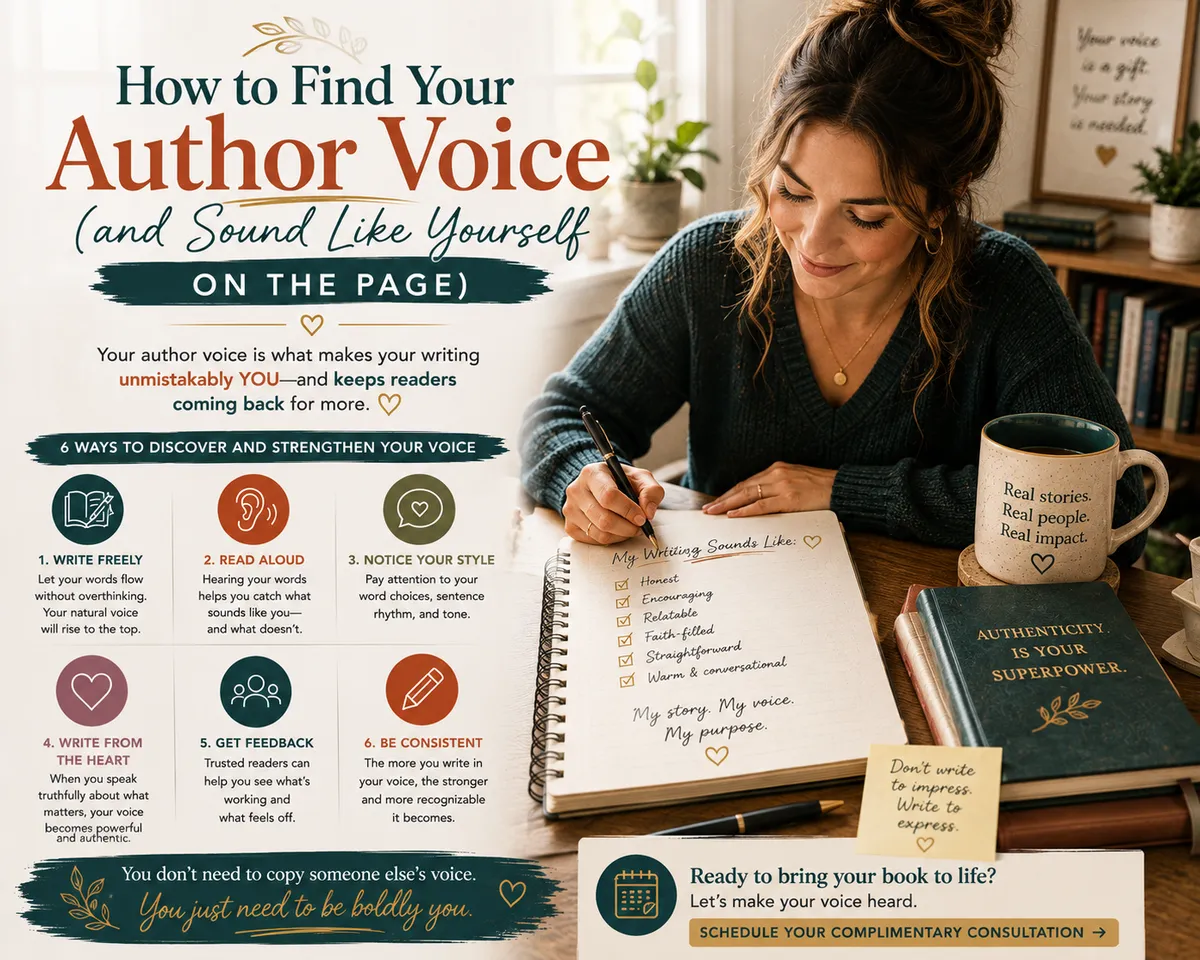
How to Find Your Author Voice (and Sound Like Yourself on the Page)
Have you ever written something, read it back, and thought, “This doesn’t sound like me at all”? You sit down to write and suddenly you’re stiff, formal, and dull — nothing like the person your friends know. That gap between how you are and how you write is a voice problem, and it’s one of the most common struggles new authors face.
Your author voice is your personality on the page. It’s the particular way you see the world and put it into words — your rhythm, your humor, your warmth, your honesty. It’s what makes readers feel like they’re spending time with a real person, not reading a report. And here’s the encouraging news: you already have one. You don’t have to invent a voice. You have to uncover the one that’s already yours.
This guide shows you what author voice really is and how to find and free yours.
“Let your speech always be gracious, seasoned with salt.” — Colossians 4:6
Your words carry your seasoning — your unique flavor. Let’s help it come through.
What Author Voice Actually Is
Author voice is the sum of the choices, big and small, that make your writing sound like you. It includes:
- Word choice — the everyday words you naturally reach for.
- Rhythm and sentence length — whether you write in short punches or flowing lines.
- Tone — warm, bold, gentle, funny, reverent, direct.
- Perspective — the way you see and interpret things.
- Honesty — how openly you let the reader in.
Voice isn’t about fancy vocabulary or literary tricks. Often, the strongest voices are the simplest and most honest. Voice is less about adding something impressive and more about removing everything that isn’t you.
Why New Authors Lose Their Voice
If you already have a voice, why does writing so often feel stiff? Usually because of what happens the moment we try to write “properly.”
Common voice-killers include:
- Trying to sound smart. We reach for big words and formal phrasing we’d never use in conversation.
- Imitating other authors. Admiring a writer is good; erasing yourself to copy them is not.
- Fear of judgment. Worrying what people will think makes us hide behind safe, generic prose.
- Writing like a textbook. We confuse “professional” with “lifeless.”
Every one of these pulls you away from your natural voice. The path back is simple, though it takes a little courage: stop performing and start sounding like yourself.
Step 1: Write Like You Talk
The fastest way to find your voice is to notice how you naturally speak, then let your writing sound more like that. You already have a compelling voice — you use it every day in conversation.
Try this: explain your topic out loud, as if to a friend across the table. Record yourself. Then listen back and notice your natural phrasing, your warmth, the way you make a point. That’s your voice. Your job on the page is to get closer to it, not further from it.
This is also why many authors write better by dictating first. Speaking bypasses the stiff “writing brain” and lets your real voice out.
Step 2: Read Your Work Out Loud
Your ear knows your voice better than your eye does. Reading your writing aloud instantly reveals where you sound like yourself and where you sound like a stranger.
When you hit a sentence you’d never actually say — one that feels formal or clunky in your mouth — rewrite it the way you’d say it. Do this throughout your manuscript and your voice grows stronger and more consistent. If it sounds like you when you read it, it’ll sound like you to your reader.
Step 3: Stop Trying to Impress
Much of what strangles author voice is the quiet desire to sound impressive. But readers aren’t looking for impressive. They’re looking for real. They want to feel understood, guided, and connected to a person.
Give yourself permission to write plainly. Use the simple word instead of the fancy one. Say the true thing instead of the clever thing. Paradoxically, this makes your writing more powerful, not less. Clarity and honesty are magnetic. Pretension pushes readers away.
Step 4: Let Your Values Show
Your voice isn’t only how you write — it’s what you care about. The things you believe, value, and return to again and again are part of your voice. For faith-driven authors, this often means letting your faith shape your words naturally, not as a performance but as an honest expression of who you are.
Don’t scrub your convictions out to sound “neutral.” A voice with nothing behind it is forgettable. A voice rooted in real values and conviction is one readers trust and remember.
Step 5: Write Enough to Find It
Here’s a freeing truth: you don’t find your voice by thinking about it. You find it by writing. Voice emerges through practice, the way your handwriting became distinctly yours through years of writing.
So give yourself permission to write imperfectly at first. Early pages might sound a little forced. Keep going. Somewhere in the writing, you’ll relax, forget you’re “being an author,” and your real voice will show up. The more you write, the clearer and stronger it becomes. Consistency reveals voice.
A Quick Exercise to Hear Your Voice
Here’s a simple exercise that reveals your natural voice almost instantly. Pick something you care about — a lesson from your book, a story you love to tell — and record yourself explaining it out loud to an imaginary friend for two minutes. Don’t script it. Just talk.
Then transcribe what you said, word for word. Read it back. You’ll notice something: it sounds like you. The rhythm, the warmth, the way you emphasize things — that’s your voice, captured. Now compare it to a paragraph you wrote “properly.” The gap between the two shows you exactly how far your writing has drifted from your natural voice, and gives you a target to write toward.
Do this a few times and your ear will start to recognize when you’re writing like yourself and when you’re performing.
Does Voice Change by Type of Book?
Your core voice stays yours across everything you write, but its expression shifts a little by genre. A memoir invites your most personal, reflective voice. A business book calls for your confident, clear, teaching voice. A devotional leans into your warm, encouraging voice. These aren’t different people — they’re different settings of the same instrument. The through-line is always authenticity. Whatever you’re writing, readers should still feel you behind the words.
Voice Isn’t Grammar (Don’t Confuse the Two)
New authors sometimes worry that finding their voice means breaking the rules of good writing. It doesn’t. Voice and correctness live on different layers.
Grammar, spelling, and clarity are the mechanics — they should be clean so nothing distracts the reader. Voice is the personality that comes through within those clean mechanics. You can write in perfectly correct sentences and still sound completely like yourself.
So don’t use “voice” as an excuse for sloppy writing, and don’t let “correctness” flatten your personality into something lifeless. The best books are both: polished and alive. A skilled editor helps you keep the mechanics clean while protecting the voice underneath, giving you writing that’s professional and unmistakably yours.
Voice and Consistency Across Your Book
Once you’ve found your voice, aim to keep it consistent throughout your book. Readers should feel the same person guiding them from the first page to the last. This is one of the quiet benefits of professional editing — a good editor helps smooth the places where your voice wavers while carefully protecting what makes it yours.
A word of caution here: editing should refine your voice, never erase it. The goal is a cleaner version of you, not a generic version of “correct.” As you shape your book — from your book outline to your final draft — protect the voice that makes it unmistakably yours.
You Don’t Have to Find It Alone
For some authors, especially those writing their first book, the voice on the page never quite matches the person. You know you’re warm and compelling in conversation, but it won’t transfer to the page. That’s a common and fixable problem.
This is one reason interview-based writing is so powerful. At The 1 and Only Publishing, when we help authors through ghostwriting, we capture your actual voice — your phrasing, your warmth, your way of explaining things — through conversation, so the finished book sounds like you at your best. Whether we coach you to find your voice or help capture it, the goal is always the same: a book that’s unmistakably yours.
Your voice is a gift no one else has. The world doesn’t need another generic book. It needs the one only you can write, in the voice only you have.
Frequently Asked Questions
What is author voice?
Author voice is your personality expressed on the page — your natural word choice, rhythm, tone, perspective, and honesty. It's what makes writing feel like time spent with a real person. You already have a voice; the work is uncovering it rather than inventing one.
Why does my writing sound stiff and unlike me?
Usually because you're trying to sound "proper" — reaching for big words, imitating other authors, or writing like a textbook. Fear of judgment also pushes writers toward safe, generic prose. The fix is to stop performing and write more like you naturally talk.
How do I find my writing voice?
Write the way you talk, read your work aloud, and rewrite anything you'd never actually say. Stop trying to impress and aim for clarity and honesty instead. Most of all, keep writing — voice emerges through practice, not through thinking about it.
Can editing ruin my author voice?
Good editing refines your voice; it should never erase it. The goal is a cleaner version of you, not a generic "correct" version. A skilled editor protects what makes your writing distinctly yours while smoothing the rough spots.
What if my writing just won't sound like me?
This is common, especially for first-time authors. Try dictating your book out loud, since speaking often unlocks your natural voice. Many authors also use interview-based writing, where a ghostwriter captures their real voice through conversation and shapes it into the finished book.
Write · Publish · Impact · Legacy
Want a Book That Actually Sounds Like You?
Book a free consultation and we’ll help you find — or capture — your authentic author voice, so your finished book reads unmistakably as yours.
Schedule Your Free Consultation →Free consultation · No obligation · A clear next step for your book