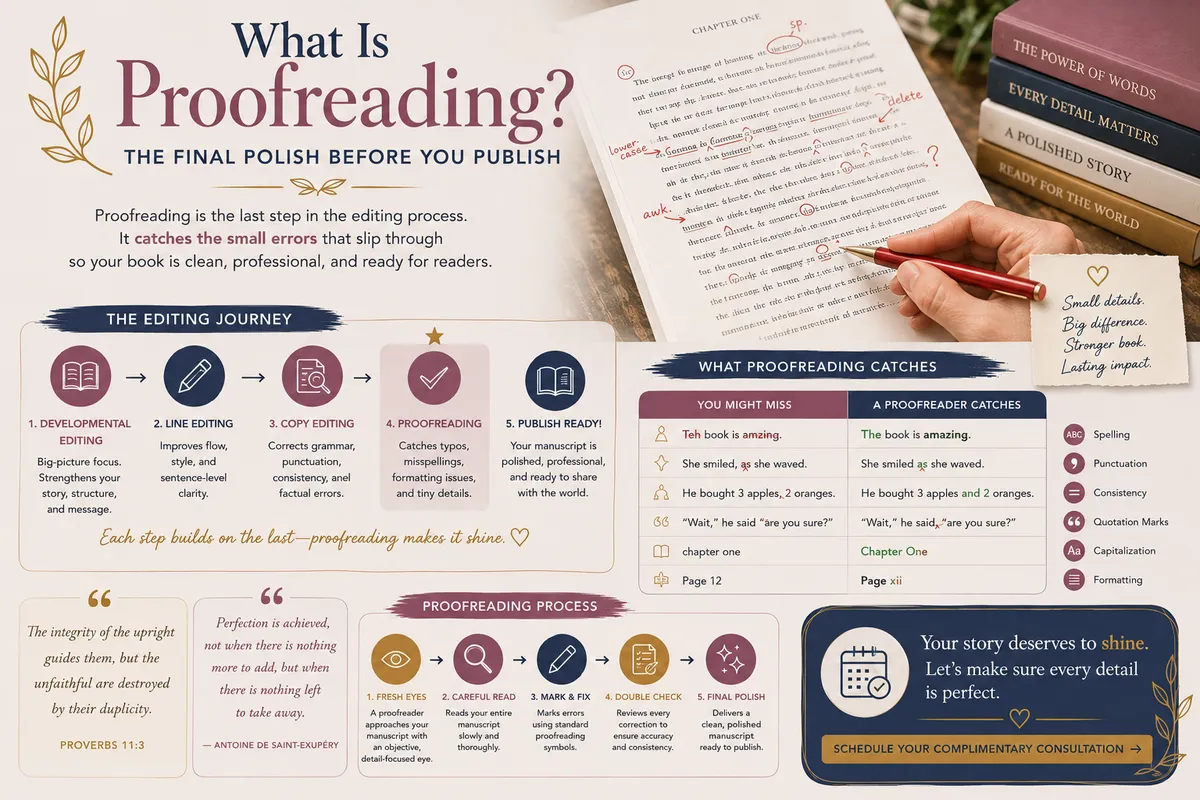
What Is Proofreading? The Final Polish Before You Publish
Imagine a reader opening your finished book, moved by your message — and then hitting a glaring typo on the first page. In an instant, a little of their trust slips away. That’s the moment proofreading exists to prevent.
Proofreading is the final quality check of your manuscript: the last set of eyes that catches the typos, misspellings, and small slips that survived every earlier stage. It’s not glamorous, and it won’t reshape your book. But it’s the difference between a book that looks professionally produced and one that quietly signals “amateur” to every reader.
This guide explains what proofreading is, how it differs from editing, and how to give your book the clean, polished finish your message deserves.
“One who is faithful in a very little is also faithful in much.”
— Luke 16:10
Small things matter. The care you show in the tiniest details tells readers something about the care behind the whole book.
What Proofreading Actually Is
Proofreading is the final review of a manuscript, performed after all the editing is complete. Its job is narrow but important: to catch the surface-level errors that remain right before the book goes to print or publication.
A proofreader looks for things like:
- Typos and misspellings that slipped through.
- Missing or doubled words (“the the,” or a dropped “not”).
- Punctuation slips — a missing period, a stray comma.
- Spacing and formatting glitches — double spaces, inconsistent indents.
- Small consistency issues — a heading style that changed, a misnumbered page.
Notice what proofreading does not do. It doesn’t rewrite clunky sentences, fix your structure, or improve your word choices — those belong to earlier editing stages. Proofreading is the final sweep, assuming the writing itself is already polished.
Proofreading vs. Editing: The Key Difference
New authors often use “editing” and “proofreading” interchangeably, but they’re different jobs at different stages. Editing improves your writing; proofreading cleans up what’s already been improved.
| Editing | Proofreading | |
|---|---|---|
| Purpose | Improve the writing | Catch remaining errors |
| Scope | Structure, style, grammar | Surface typos and slips |
| When | Earlier stages | The final stage |
| Result | A better book | A clean book |
Here’s the important takeaway: proofreading is not a substitute for editing. Hiring a proofreader to “fix up” an unedited manuscript will leave you with clean typos on top of unaddressed structural and stylistic problems. Proofreading is the finishing touch, not the whole job.
Why Proofreading Is So Hard to Do on Your Own
You’ve read your manuscript a hundred times. So why do typos still slip through? Because of how your brain works. When you know what a sentence is supposed to say, your mind fills in the gaps and “reads” the correct version — even when a word is missing or misspelled. You literally can’t see the error, because you’re seeing your intention.
This is why even brilliant writers miss typos in their own work, and why professional proofreaders exist. Fresh, trained eyes catch what the author’s brain automatically corrects. It’s not a matter of intelligence or carefulness; it’s simply how familiarity works.
“Have no fear of perfection — you’ll never reach it.”
— Salvador Dalí
There’s freedom in that. Proofreading isn’t about achieving an impossible flawlessness; it’s about catching what you reasonably can so your message shines through clean.
Practical Proofreading Tips
If you want to proofread your own work (or clean it up before a professional does), these techniques genuinely help trick your brain into seeing what’s actually there:
- Take a break first. Step away for a few days. Distance helps you see the text with fresher eyes.
- Read it out loud. Your ear catches missing words and awkward slips your eye glides past.
- Change how it looks. Alter the font, size, or color, or read it on a different device. New formatting breaks the familiarity that hides errors.
- Read backward. Reading sentences from the last to the first forces you to focus on words individually, not meaning.
- Use tools — but don’t trust them fully. Spell-checkers catch some errors and miss others (they won’t flag “form” when you meant “from”). Use them as a first pass, not a final word.
- Proofread when you’re fresh. Tired eyes miss more. Do it when you’re alert, not at midnight.
These tips will improve your results — but be honest about the limits of self-proofreading. For a book you’re publishing, a second set of professional eyes is one of the wisest small investments you can make.
When to Bring in a Professional
For a personal document, self-proofreading is fine. For a book with your name on it — one you hope readers will trust, recommend, and remember — professional proofreading is strongly worth it. A clean book protects your credibility and honors the reader.
A professional proofreader brings trained eyes, knowledge of publishing conventions, and, crucially, the distance you can’t have from your own work. They catch what you’ve become blind to after months with your manuscript.
A Quick Proofreading Checklist
When you (or a professional) do a final proofread, these are the items worth a focused look:
- Misspelled or misused words, including correctly spelled wrong words (“their” vs “there”).
- Missing or repeated words (“the the,” a dropped “not”).
- Punctuation slips — missing periods, stray or missing commas, mismatched quotation marks.
- Inconsistent spacing, indents, or line breaks.
- Numbers, dates, and names that should match but don’t.
- Heading and chapter-title formatting that’s out of step with the rest.
- Page numbers and running headers that are correct and in order.
Working through a defined list keeps your final pass focused, so you’re checking specific things rather than vaguely “looking for errors.”
Proofreading for Print vs. Ebook
One detail authors overlook: print and ebook versions each need their own proofread. A book can look flawless as a manuscript and still develop new issues when it’s formatted. In print, watch for awkward page breaks, hyphenation at line ends, and headers or page numbers that drift. In an ebook, check that the text reflows properly on different screen sizes, that links work, and that chapter breaks land correctly.
Proofreading the formatted version — ideally a proof copy or preview that looks like the finished book — catches problems that never appear in the working document. It’s the last safeguard before readers see your book.
Why One Careful Proofread Isn’t Always Enough
Even a skilled proofreader can miss the occasional error in a single pass — that’s simply the nature of detailed work on a book-length document. For this reason, many professional books receive more than one proofreading pass, or a proofread followed by a final check of the formatted proof copy. Each pass catches a little more.
This isn’t a reason for anxiety or endless checking. It’s simply why a systematic, multi-step final review matters more than one hurried read. When your book has been proofread carefully — ideally more than once, and including the formatted version — you can trust that you’ve done the diligent work of giving readers a clean, professional book.
The Real Cost of Skipping Proofreading
It’s tempting to view proofreading as optional — the writing is done, so why pay for one more pass? But skipped proofreading tends to announce itself. Readers notice typos, and many quietly lower their opinion of the whole book because of them, fairly or not. Reviewers sometimes mention errors directly, and a few visible mistakes can pull an otherwise glowing review down a star. For a business or authority book, sloppy errors can even undercut the credibility you’re trying to build.
None of that means your book must be flawless — it means the final polish is worth it. Proofreading is usually the most affordable editing step, and it protects everything else you’ve invested. Few small expenses do more to guard your book’s reputation.
You Don’t Have to Catch Every Error Alone
Here’s the reassuring truth: no author can fully proofread their own book, and no one expects you to. The invisible-error problem affects everyone, from first-timers to bestsellers. Needing a proofreader isn’t a sign of weak writing; it’s a sign of a professional approach.
At The 1 and Only Publishing, proofreading is the final step in preparing your manuscript for the world — the last polish that makes sure your finished book is as clean as your message is powerful. You’ve worked too hard for a stray typo to undercut a reader’s trust on page one.
Your message deserves a book that looks as professional as it truly is. A careful final polish makes sure nothing distracts from the words that matter.
Frequently Asked Questions
What is the difference between proofreading and editing?
Editing improves your writing — its structure, style, and grammar — across several earlier stages. Proofreading is the final step that catches remaining surface errors like typos, missing words, and spacing slips. Editing makes a book better; proofreading makes it clean. Proofreading is not a substitute for editing.
Can I proofread my own book?
You can improve it with techniques like reading aloud, taking a break, and changing the text's appearance. But it's very hard to fully proofread your own work, because your brain automatically "corrects" errors it knows should say something else. For a published book, professional proofreading is strongly recommended.
Why do I still miss typos after reading my book many times?
Because familiarity works against you. When you know what a sentence should say, your mind fills in the gaps and reads the intended version, even when a word is misspelled or missing. Fresh, trained eyes catch what your brain automatically corrects.
Is spell-check enough for proofreading?
No. Spell-checkers catch some errors but miss many — they won't flag a correctly spelled wrong word, like "form" instead of "from," or subtle consistency issues. Use them as a first pass, but don't rely on them as your final proofread.
When should proofreading happen?
Proofreading is the very last step, after all developmental, line, and copy editing are complete and the book is formatted. It assumes the writing is already polished and simply catches the final surface errors before the book goes to print or publication.
Write · Publish · Impact · Legacy
Almost Ready to Publish?
Book a free consultation and we’ll help give your manuscript the clean, professional final polish your message deserves.
Schedule Your Free Consultation →Free consultation · No obligation · A clear next step for your book