How Much Does Book Editing Cost? An Honest Breakdown
If you're planning to publish a book, one question shows up fast: how much does editing actually cost? It's a fair and important question, and unfortunately one that many websites answer with vague ranges or none at all. You deserve an honest, practical breakdown so you can budget with confidence.
The truthful answer is that editing costs vary widely, because they depend on real factors like your book's length, its condition, and the type of editing it needs. But you can absolutely understand the landscape and make wise decisions, even on a limited budget.
This guide gives you an honest look at what affects editing costs, what to reasonably expect, and how to invest your money where it matters most.
“Buy truth, and do not sell it; buy wisdom, instruction, and understanding.”
Proverbs 23:23
Some things are worth investing in. Quality that carries your message well is one of them.
First: Why Editing Costs What It Does
Before looking at numbers, it helps to understand what you're actually paying for. Professional editing is skilled, time-intensive work. An experienced editor spends many hours carefully reading, thinking about, and improving your manuscript, often reading it multiple times. You're paying for their training, their expertise, and hours of focused attention on your book.
That's why editing is one of the more significant investments in publishing. It's also why it's one of the most valuable: editing is what separates a professional book from an amateur one.
“Price is what you pay. Value is what you get.”
Warren Buffett
Buffett's wisdom is the right lens for editing. The price is what leaves your budget; the value is a book that earns readers' trust, respect, and recommendations for years to come.
What Affects the Cost of Editing
Several factors influence what you'll pay. Understanding them helps you see why quotes vary and how to plan:
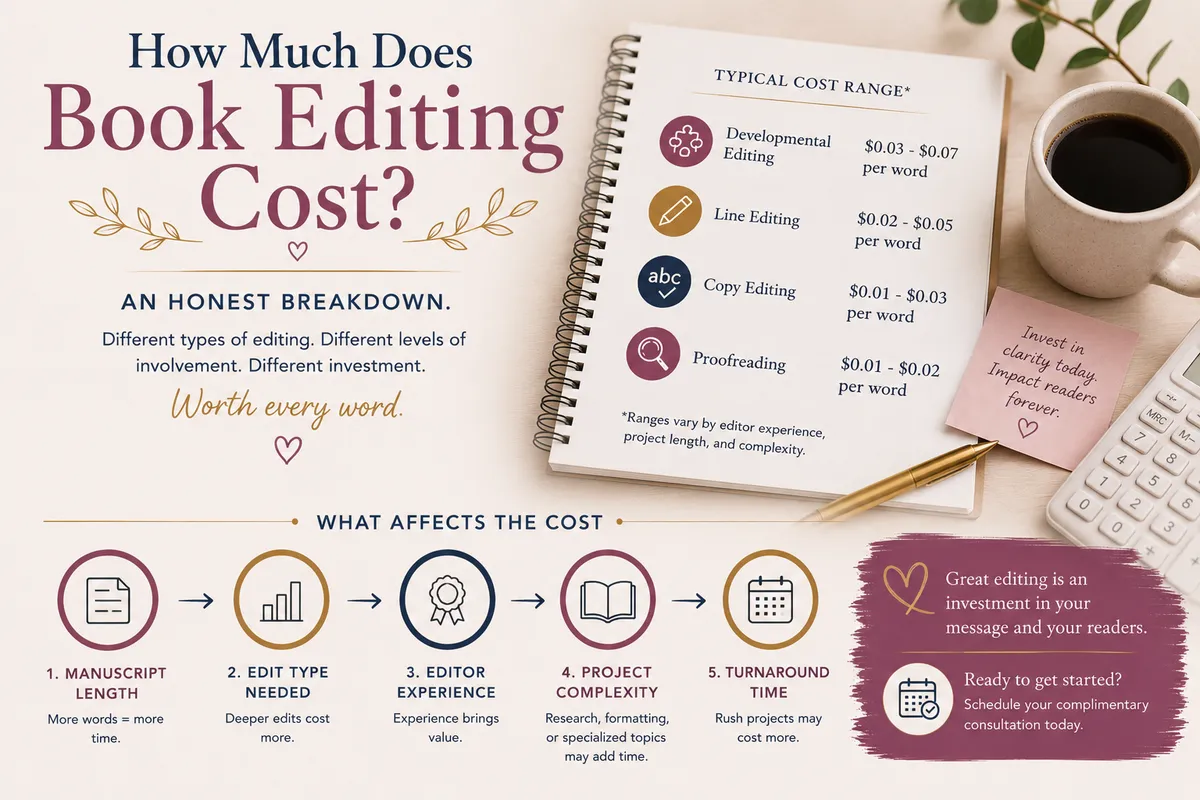
- Type of editing. Developmental editing (the deepest) generally costs more than copy editing, which costs more than proofreading (the lightest). More intensive work takes more time.
- Length of your book. Most editing is priced by word count or page count, so a 90,000-word book costs more to edit than a 30,000-word one.
- Condition of your manuscript. A clean, well-prepared draft takes less time than a rough one. Preparing your manuscript well can genuinely lower your cost.
- The editor's experience. Seasoned editors with strong track records typically charge more than beginners, and often deliver more value.
- Turnaround time. Rush jobs may cost extra.
Because of these variables, the same book can receive very different quotes. That's normal. What matters is understanding what's included and whether the editor is a good fit.
How Editing Is Usually Priced
Editors typically price their work in one of a few ways, and knowing them helps you compare quotes:
- Per word: a set rate multiplied by your word count (common and transparent).
- Per page: a rate based on a standard manuscript page.
- Per hour: based on the time the edit takes.
- Per project: a flat fee for the whole book, agreed upfront.
Many authors prefer per-word or per-project pricing because it's predictable: you know the cost before you commit. When comparing quotes, make sure you're comparing the same type and depth of editing, not just the bottom-line number.
Getting a Sense of Ranges
Editing rates vary by editor, region, and market, so any figure is a general guideline rather than a fixed price. For current, credible benchmarks, the Editorial Freelancers Association publishes editorial rate ranges by service type that many authors and editors reference. It's a helpful starting point for setting realistic expectations.
As a general principle, expect developmental editing to be the largest editing investment (because it's the most intensive), copy editing to fall in the middle, and proofreading to be the most affordable. When you request a quote, ask the editor to explain exactly what's included so you can weigh the value, not just the price.
How to Invest Wisely on a Budget
Not everyone can afford every type of editing, and that's okay. Here's how to make smart choices when your budget is limited:
Prioritize your biggest weakness. If your structure is shaky, developmental editing will do the most good. If your writing is strong but you're worried about errors, copy editing or proofreading may be enough. Spend where your book needs it most.
Prepare your manuscript well. A cleaner draft can lower your editing cost. Our final manuscript checklist shows you what to check before you hand it over.
Do thorough self-editing first. The more you can strengthen on your own, the more focused (and sometimes affordable) the professional edit becomes.
Don't skip editing entirely to save money. This is the most expensive mistake of all. An unedited book can undercut your credibility, hurt your reviews, and waste everything else you invested in the book.
Look at editing as part of your total budget. Editing, design, and formatting together create a professional book. Plan for editing as an essential line item, not an afterthought.
Is Editing Worth the Cost?
For a book you're publishing under your name, the honest answer is almost always yes. Editing is what makes your book credible, readable, and professional. Readers can tell the difference between an edited and unedited book within a few pages, and that difference shapes reviews, recommendations, and how your message is received.
Think of editing not as an expense but as protection for your investment. You've poured your heart, time, and money into your book. Editing ensures all of that is delivered to readers at its very best.
Why Cheap Editing Can Be Expensive
When budgets are tight, the cheapest quote is tempting, but editing is one area where the lowest price often costs more in the end. An inexperienced or rushed editor may miss real issues, introduce new errors, or fail to strengthen your book in the ways that matter. You can end up paying twice: once for the weak edit, and again to have it done properly.
This doesn't mean the most expensive editor is always best, either. The goal is value: an editor whose skill and care match what your book needs. Look at experience, samples, and reviews, not just the number at the bottom of the quote. A fair price for genuinely good editing is one of the wisest investments you'll make in your book.
Questions to Ask Before You Pay
Before committing to an editor, a few questions protect your investment: What type and depth of editing does this quote cover? How many rounds are included? What will I receive when it's done (tracked changes, an editorial letter)? Can you do a short sample edit so I can see your approach? What's your experience with books like mine? Clear answers help you compare quotes fairly and choose the editor who offers the most value for your specific book, not just the lowest price.
Ways to Make Editing More Attainable
If a full editing budget feels out of reach right now, you have options beyond simply skipping it. Some authors phase their editing over time, saving for the most important edit first, then budgeting for the next. Others ask whether a publisher or editor offers payment plans that spread the cost into manageable pieces. You can also reduce the load (and the price) by doing thorough self-editing and preparing your manuscript carefully before handing it over. The goal isn't to cut corners on quality; it's to reach professional quality in a way that fits your circumstances. A good publishing partner will work with you to find a realistic path, because your message deserves to be published well regardless of your starting budget.
You Don't Have to Figure This Out Alone
Budgeting for a book can feel daunting, especially when you're not sure what editing you need or what's reasonable to pay. You shouldn't have to guess, or feel pressured into services that don't fit your book or your budget.
At The 1 and Only Publishing, we believe in honest, transparent guidance. We'll assess what your manuscript actually needs, explain your options clearly, and help you invest where it counts, so you get a professional book without paying for things you don't need. You can see our starting prices on our investment page, or buy editing on its own in our publishing store.
Your message is worth investing in. With wise planning, you can give your book the professional editing it deserves and send it into the world at its very best.
This article offers general educational information about editing costs, not a specific quote or financial advice. Actual prices vary by editor and project.
Frequently Asked Questions
How much does it cost to edit a book?
It varies widely based on the type of editing, your book's length and condition, and the editor's experience. Developmental editing is generally the largest editing investment, copy editing falls in the middle, and proofreading is the most affordable. For credible benchmarks, the Editorial Freelancers Association publishes rate ranges by service.
Which type of editing is most expensive?
Developmental editing typically costs the most, because it's the deepest and most time-intensive: the editor shapes your book's structure, content, and clarity. Copy editing costs less, and proofreading, the lightest touch, is usually the most affordable.
How can I reduce my editing costs?
Prepare your manuscript well and do thorough self-editing first, since a cleaner draft often takes less time to edit. Prioritize the editing your book needs most rather than paying for everything. Just don't skip professional editing entirely; that's the costliest mistake of all.
How do editors charge for their work?
Commonly per word, per page, per hour, or per project (a flat fee). Many authors prefer per-word or per-project pricing because the cost is predictable. When comparing quotes, make sure you're comparing the same type and depth of editing, not just the final number.
Is professional editing really worth the cost?
For a book published under your name, almost always yes. Readers notice the difference between edited and unedited books within a few pages, and it affects reviews and recommendations. Editing protects everything else you invest in your book, making it credible, readable, and professional.
Write · Publish · Impact · Legacy
Budgeting for Your Book?
Book a free consultation and we'll give you honest, transparent guidance on exactly what editing your manuscript needs, so you invest where it counts.
Schedule Your Free Consultation →Free consultation · No obligation · A clear next step for your book