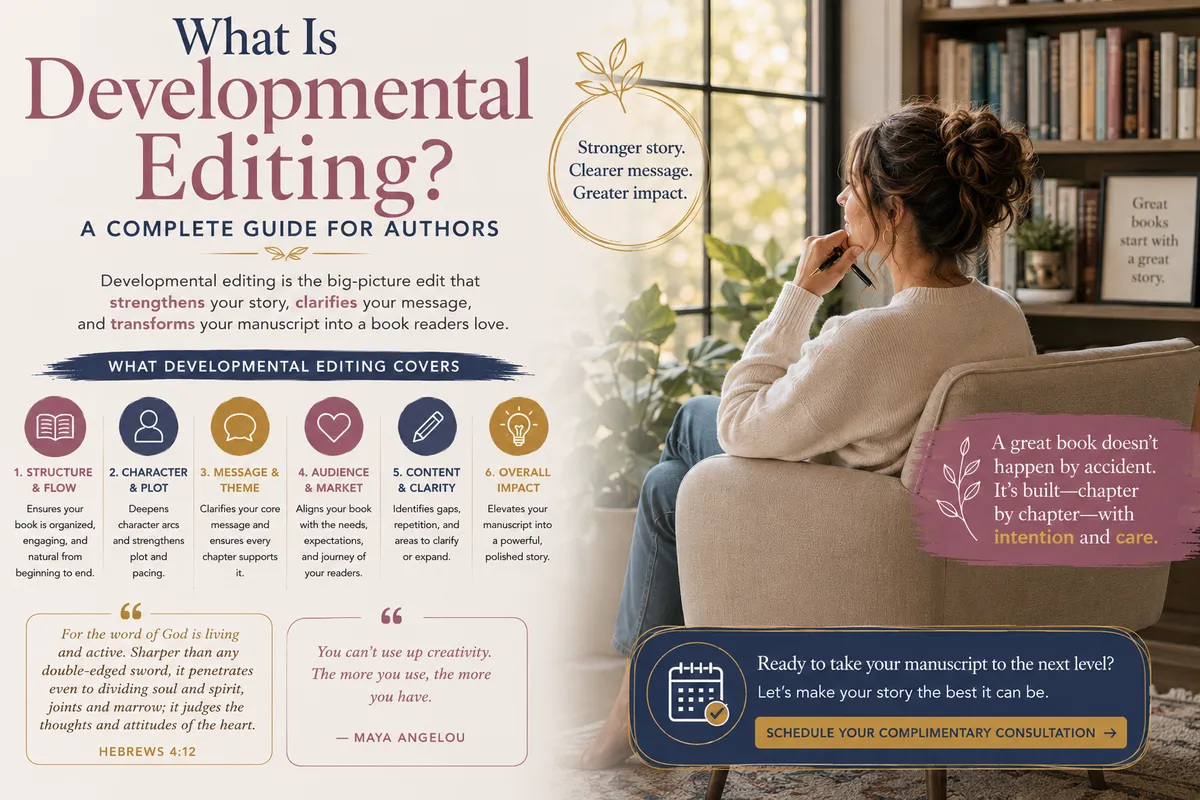
What Is Developmental Editing? A Complete Guide for Authors
You finished your manuscript. That alone is a triumph most people never reach. But now you’re staring at your draft with a nagging question: is it actually good? Does it flow? Will readers stay with it to the end? Those questions land squarely in the world of developmental editing — the deepest, most transformative edit your book will ever receive.
Developmental editing is where a rough manuscript becomes a real book. It’s not about commas and typos; those come much later. It’s about the big picture: your book’s structure, clarity, message, and whether it delivers on its promise to the reader. If you only invest in one kind of editing, this is the one that changes everything.
This guide explains what developmental editing is, what it includes, and how to know if your book needs it.
“And I am sure of this, that he who began a good work in you will bring it to completion.”
— Philippians 1:6
The work you’ve started deserves to be brought to completion — and completion means more than a finished draft. It means a book shaped to its full potential.
What Developmental Editing Actually Is
Developmental editing (sometimes called structural, content, or substantive editing) is the highest-level edit of a manuscript. It looks at your book as a whole and asks the biggest questions:
- Is the structure logical and compelling?
- Does each chapter earn its place?
- Is the message clear and consistently delivered?
- Are there gaps, repetitions, or places where readers will get lost?
- Does the book actually accomplish what it set out to do?
A developmental editor reads not just to catch errors, but to understand your vision — and then helps you close the gap between what you meant to say and what’s actually on the page. It’s the most collaborative, creative, and impactful stage of the entire editing process.
“There is no great writing, only great rewriting.”
— Louis D. Brandeis
That truth sits at the heart of developmental editing. Great books aren’t written; they’re rewritten — and a developmental editor is your guide through that rewriting.
What a Developmental Edit Includes
While every manuscript is different, a developmental edit typically addresses several core areas.
Structure and organization. The editor evaluates the order of your chapters and sections. Does the book build logically? Should a chapter move, split, or merge? For a memoir, does the timeline work? For a nonfiction book, does each chapter build on the last?
Clarity of message. Every book makes a promise. A developmental editor makes sure yours is clear from the first page and fulfilled by the last, flagging places where the message drifts or gets muddy.
Content gaps and excess. The editor spots where you’ve left something out that readers need — and where you’ve included something that slows the book down. This is often where authors must cut beloved passages that don’t serve the reader.
Pacing and flow. Some sections drag; others rush. A developmental editor helps you balance the rhythm so readers stay engaged from beginning to end.
Audience alignment. The editor keeps your specific reader in view, making sure the tone, depth, and language fit the people your book is meant to serve.
How Developmental Editing Differs From Other Edits
One of the most common points of confusion for new authors is how the different types of editing relate. Here’s a simple way to picture it:
| Edit Type | What It Fixes | When It Happens |
|---|---|---|
| Developmental editing | Structure, clarity, content, message | First — on the full draft |
| Line editing | Sentence flow, tone, word choice | After the structure is solid |
| Copy editing | Grammar, consistency, accuracy | After line editing |
| Proofreading | Typos, final surface errors | Last — before publishing |
Notice the order. Developmental editing comes first for a reason. There’s no sense in perfecting the grammar of a chapter that developmental editing will end up cutting or rewriting. You shape the house before you polish the windows.
Signs Your Book Needs Developmental Editing
Not sure if this is the edit for you? These signs suggest a developmental edit would be valuable:
- You’ve finished a draft but sense that “something isn’t working” and can’t name it.
- Readers say they lost interest partway through, but you don’t know why.
- You have great material but aren’t sure it’s in the right order.
- Your book feels more like a collection of thoughts than a cohesive whole.
- This is your first book, and you want to make sure the foundation is strong.
If any of these resonate, you’re not failing — you’re at exactly the point where most books benefit from an experienced outside perspective.
What to Expect From the Process
A developmental edit usually unfolds in a few stages. First, the editor reads your entire manuscript to understand it as a whole. Next, they provide an editorial letter — a detailed document explaining the book’s strengths, its opportunities, and specific recommendations for improvement. Many also leave in-manuscript notes pointing to particular passages.
Then comes your part: revising based on that guidance. A good developmental editor doesn’t rewrite your book for you or replace your voice. They illuminate the path and let you walk it, so the finished book is still unmistakably yours — just stronger.
This back-and-forth is why developmental editing is so powerful. It’s not a service done to your manuscript; it’s a partnership that helps you become a better author in the process.
Why This Edit Matters So Much
Skipping developmental editing is one of the most common reasons self-published books underperform. A book can have flawless grammar and still fail because its structure is confusing or its message never lands. Readers rarely finish a book that loses them, no matter how clean the typos.
Investing in developmental editing protects everything else you’ll pour into your book — the cover, the marketing, the launch. It ensures that when readers open your book, they meet a clear, compelling, well-built work worthy of the message inside it.
For faith-driven authors especially, this matters. Your book carries a message you believe can change lives. That message deserves to be delivered with excellence, not buried in a manuscript that never quite came together.
What Developmental Editing Is Not
Because developmental editing is so deep, authors sometimes fear it means handing their book over to someone who will change everything. It helps to be clear about what it is not:
- It’s not ghostwriting. The editor doesn’t write the book for you; they help you strengthen what you’ve written.
- It’s not proofreading. They’re not hunting typos at this stage — that comes much later.
- It’s not a rewrite of your voice. A good developmental editor sharpens your message while protecting the way you say it.
- It’s not criticism for its own sake. Every note exists to serve the reader and your goal for the book.
Understanding this removes the fear. Developmental editing is a partnership that keeps you in the author’s seat while giving you an experienced guide.
Developmental Editing for Different Types of Books
While the goal is always a stronger book, the focus shifts depending on what you’re writing. In a nonfiction or how-to book, developmental editing makes sure each concept is clear, well-ordered, and genuinely useful to the reader. In a memoir or testimony, it focuses on narrative flow, emotional honesty, and whether the story’s meaning comes through. In a business book, it sharpens your framework and makes sure your expertise translates into something readers can actually apply.
Whatever your genre, the editor’s job is the same: to help your book become the clearest, most compelling version of itself, so your message reaches readers exactly as you intend.
How Long Does Developmental Editing Take?
Because it’s the deepest edit, developmental editing takes time — both for the editor to do thoughtfully and for you to revise afterward. For a full-length book, the editor’s review often takes several weeks, and your revision based on their guidance can take weeks more. That may sound long, but it’s time well spent: this is the stage that determines whether your book truly works. Rushing it undermines everything that follows. Building a realistic timeline for developmental editing into your publishing plan keeps you from feeling pressured to cut corners on the edit that matters most.
You Don’t Have to Shape It Alone
Here’s the encouraging truth: nearly every strong book you’ve ever read passed through the hands of a developmental editor. Even seasoned authors can’t fully see their own work, because they’re too close to it. That’s not a weakness — it’s simply how writing works.
At The 1 and Only Publishing, developmental editing is at the heart of what we do. We help authors take a rough or uncertain draft and shape it into a book that’s clear, compelling, and true to their vision — all while protecting the voice and message that make it theirs. If you have a draft and a sense that it could be more, that’s exactly where we love to begin.
Your manuscript is a beginning, not a finished thing. With the right shaping, the book you’ve imagined can become the book readers can’t put down.
Frequently Asked Questions
What is developmental editing in simple terms?
Developmental editing is big-picture editing. Instead of fixing grammar or typos, it focuses on your book's structure, clarity, content, and message — making sure the whole book is well-organized, compelling, and delivers on its promise to the reader. It's usually the first and most transformative edit a manuscript receives.
Do I need developmental editing or just proofreading?
It depends on your draft. If you only need typos and surface errors fixed, that's proofreading. If your book has structural, clarity, or flow issues — or if it's your first book — developmental editing addresses those deeper concerns first. Proofreading a book with structural problems won't fix why readers lose interest.
When should developmental editing happen?
Developmental editing comes first, on your complete draft, before line editing, copy editing, and proofreading. This order matters: there's no point perfecting the grammar of passages that developmental editing may end up cutting or reworking. You shape the book, then polish it.
Will a developmental editor change my voice?
A good developmental editor protects your voice rather than replacing it. They point out what's working and what could be stronger, then let you revise. The finished book should still sound unmistakably like you — just clearer, better organized, and more compelling.
How is developmental editing different from ghostwriting?
Ghostwriting is writing the book for you (often from your ideas or interviews). Developmental editing works with a draft you've already written, helping you strengthen and reshape it. Some authors use one, some the other, depending on whether they have a draft and how much support they want.
Write · Publish · Impact · Legacy
Have a Draft That Could Be Stronger?
Book a free consultation and we’ll help you see your book’s biggest opportunities — and shape it into a clear, compelling work that’s still unmistakably yours.
Schedule Your Free Consultation →Free consultation · No obligation · A clear next step for your book