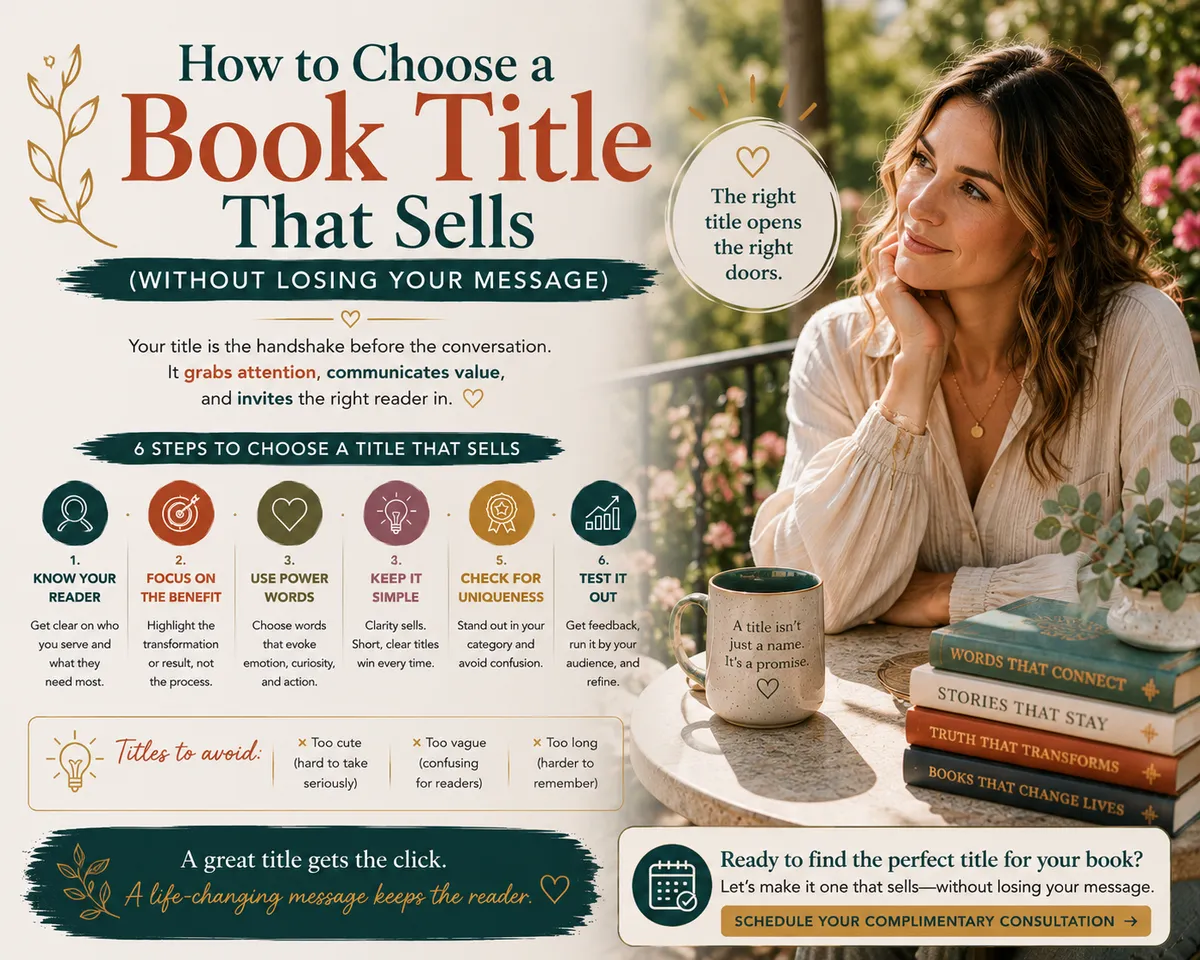
How to Choose a Book Title That Sells (Without Losing Your Message)
Your book title is the first thing a reader sees — and often the only thing they judge before deciding to look closer or scroll past. A great title can make an unknown book irresistible. A weak one can bury a brilliant book no one ever opens.
That’s a lot of pressure for a few words, which is why so many authors agonize over it. But choosing strong book titles isn’t a matter of luck or waiting for lightning to strike. It’s a skill with principles you can learn and a process you can follow.
This guide walks you through what makes a title work, a step-by-step method for finding yours, and the common mistakes that sink otherwise-good books.
“A good name is to be chosen rather than great riches.” — Proverbs 22:1
Your book’s name matters. Let’s choose it well.
What a Great Book Title Actually Does
Before you brainstorm, understand the job a title is hired to do. A strong title has to accomplish several things in just a few words:
- Grab attention — it earns a second look in a crowded shelf or search result.
- Communicate a promise — it hints at the value or transformation inside.
- Fit the genre — it signals whether this is a memoir, a business book, or a devotional.
- Be memorable — it’s easy to recall and repeat to a friend.
- Feel true — it delivers on what the book actually is.
Most titles can’t do all of this alone, which is why the title and subtitle work as a team, especially in nonfiction. The title catches attention; the subtitle makes the promise clear.
The Title-and-Subtitle Partnership
For nonfiction, memoir, and business books, the winning formula is usually a compelling main title paired with a clarifying subtitle. This lets you have the best of both worlds: intrigue and clarity.
The pattern looks like this:
- Main title: short, memorable, emotional, or intriguing.
- Subtitle: clear, specific, and benefit-driven — it tells the reader exactly what they’ll get.
For example, an intriguing main title like Rise means little on its own. But Rise: How to Rebuild Your Life and Faith After Loss is instantly clear. The main title creates curiosity; the subtitle answers it. Together, they’re far stronger than either alone.
Step 1: Get Clear on Your Book’s Core Promise
You can’t name a book well until you’re clear on what it delivers. Return to the heart of your book: who is it for, and what transformation does it offer? A strong title almost always grows out of that promise.
Write a sentence: “This book helps [reader] achieve [transformation].” The words in that sentence are often the raw material for your title and subtitle. Clarity about your message is the foundation of a clear title.
Step 2: Brainstorm Widely (Quantity First)
Great titles rarely arrive first. So don’t try to find the title right away — generate a long list of candidates without judging them. Aim for 20, 30, even 50 options.
Pull from several angles:
- The transformation — what the reader gains (freedom, healing, growth).
- A key phrase — a memorable line from your book.
- A metaphor or image — something that captures your theme.
- The reader’s question — the very thing they’re searching to answer.
- A bold statement — a provocative or surprising claim from your message.
Write them all down. Bad ideas often spark good ones, so keep the pen moving and don’t self-edit yet.
Step 3: Test Your Top Titles
Once you have a shortlist, test your favorites against real people and practical checks. A title that sounds clever in your head may confuse or underwhelm others.
Ways to test:
- Say it out loud. Is it easy to say and remember? Awkward titles die on the vine.
- Show it to your ideal readers. Ask which title makes them want to know more — and why.
- Check the promise. Does the title (with subtitle) make clear who the book is for and what they’ll get?
- Search it online. Make sure it isn’t already used by a well-known book, which can cause confusion. (Note: book titles generally can’t be copyrighted, but a title too close to a famous one hurts you in the market.)
Real feedback beats guessing every time. Your readers will often spot the winner faster than you can.
Step 4: Make Sure It Fits Your Genre and Brand
A title should set the right expectation. A playful, punny title on a grief memoir sends the wrong signal; a heavy, somber title on a fun marketing book does the same. Your title is a promise about the experience inside — make sure it matches.
For business and authority books especially, your title also reflects your brand. It should sound like something you’d be proud to say from a stage and see on a client’s desk. If you’re writing to build authority, make sure your title supports that goal, a point we explore more in our guide on writing a business book.
Common Book Title Mistakes to Avoid
As you narrow your choices, steer clear of the traps that weaken titles:
- Being too clever. If readers have to work to understand it, most won’t bother. Clarity beats cleverness.
- Being too vague. A title so general it could belong to any book tells the reader nothing.
- Being too long or hard to say. If people can’t easily repeat it, word of mouth suffers.
- Overpromising. A title that promises more than the book delivers leads to disappointed readers and poor reviews.
- Ignoring searchability. For nonfiction especially, it helps when your title or subtitle includes words readers actually search for.
Avoiding these mistakes puts you ahead of most first-time authors.
Title Formulas That Reliably Work
If you’re stuck, proven title patterns can jump-start your brainstorm. These aren’t rules, but they’ve worked for countless books:
- The Transformation: From [bad state] to [good state] — e.g., From Broke to Blessed.
- The How-To Promise: How to [achieve desired result] — clear and searchable.
- The Number: [X] Ways / Steps / Keys to [result] — specific and skimmable.
- The Bold Statement: a provocative claim from your message that stops the scroll.
- The Metaphor + Subtitle: an evocative image up top, a clear subtitle below (Anchored: Finding Steady Faith in Unsteady Seasons).
Run a few of your ideas through each pattern. You’ll often discover a strong contender you hadn’t considered.
A Quick Book Title Checklist
Before you commit, run your favorite through this checklist. A strong title can honestly check most of these boxes:
- Is it easy to say and remember?
- Does it (with the subtitle) make the promise clear?
- Does it fit the genre and set the right expectation?
- Would your ideal reader want to know more?
- Is it distinct from well-known books?
- Are you proud to say it out loud?
If a title stumbles on several of these, keep refining. If it sails through, you may have found your winner.
It’s Okay to Decide Later
Here’s some pressure relief: you don’t need your final title before you write. Many authors work under a “working title” and land on the real one near the end, once the book has told them what it’s truly about. If you’re stuck, keep writing. The right title often reveals itself as the manuscript takes shape.
Where to Get Honest Title Feedback
You’re too close to your own book to judge its title objectively — so gather outside input before you commit. The key is asking the right people the right way.
Ask people who resemble your ideal reader, not just friends and family (who tend to praise everything). Instead of “Do you like this title?”, ask “Which of these makes you want to know more, and why?” That question surfaces honest, useful reactions. You can test titles in a small group, an email to your audience, or an informal poll.
Pay attention to which titles people remember a day later without prompting — memorability is a powerful signal. Just don’t outsource the final call. Feedback informs your decision; it doesn’t make it for you.
You Don’t Have to Choose Alone
Titling a book is part art, part strategy — and it’s genuinely hard to be objective about your own work. You’re too close to it. That’s why authors so often benefit from an outside perspective at this stage.
At The 1 and Only Publishing, helping authors land on the right title and subtitle is part of how we prepare a book for the market. We bring experience in what actually attracts readers, plus the objectivity that’s hard to have about your own book. The result is a title that’s both true to your message and built to sell.
Your book deserves a name that opens doors, not one that hides it. Choose it with care, test it with real readers, and don’t be afraid to ask for help getting it right.
Frequently Asked Questions
How do I choose a good book title?
Start with your book's core promise — who it's for and what it delivers. Brainstorm a long list of options from different angles, then test your favorites with real readers for clarity, memorability, and appeal. Pair an intriguing main title with a clear, benefit-driven subtitle.
Should my book have a subtitle?
For nonfiction, memoir, and business books, usually yes. A short, intriguing main title paired with a clear subtitle gives you both attention and clarity. The title creates curiosity, and the subtitle spells out exactly who the book is for and what they'll gain.
Can I copyright my book title?
Generally, no — individual titles typically can't be copyrighted. However, you should still avoid titles that closely match well-known books, since that can confuse readers and hurt your book in the market. For specific legal questions, consult a qualified attorney.
Do I need my title before I start writing?
No. Many authors write under a working title and choose the final one near the end, once the book reveals what it's truly about. If you're stuck on a title, keep writing — the right one often emerges as the manuscript takes shape.
How do I know if my title is any good?
Test it. Say it out loud to check that it's easy to remember, and show your shortlist to your ideal readers, asking which one makes them want to know more. Real feedback reveals the winner far more reliably than guessing on your own.
Write · Publish · Impact · Legacy
Struggling to Name Your Book?
Book a free consultation and we’ll help you choose a title and subtitle that grab attention, communicate your promise, and stay true to your message.
Schedule Your Free Consultation →Free consultation · No obligation · A clear next step for your book